Thursday, April 5, 2012

LPHS Mixed Media: Personal Narrative Collage

We began the project by looking at the season one Art 21: Identity episode followed by a series of individual and group "Close Reads" of Outsider Collage artists such as Henry Darger, Tony Fitzpatrick, Holli Schorno, and Jose Felipe Consalvos to name a few. The students were then charged with developing their own collages based on the project guidelines and the artist(s) that inspired them.


I developed a project handout format for the Mixed Media art students to begin associating SHoM language with routine lesson procedures in the classroom as they develop their individual artistic processes and styles. I aligned the habits with various lesson procedures in the instructional handout so that the students can more easily associate their work processes with the habits while making, reflecting and self-evaluating. The project handout and the rubric have been uploaded to Google Docs. I have included an excerpt of each here:

Concept: (Express, Understand Art World: Domain & Communities) Choose a topic or theme that is of interest to you, and that is important or relevant to you in your life at this time. Your chosen theme/topic should say something about you and/or your personality and interests. Your theme could be related to any or all of the following categories: Personal, political, social, spiritual and everything in between!

from procedure section:

  • Begin planning your collage on large paper. (Observe, Stretch & Explore, Engage & Persist) You may alter the size/shape of the background paper, but your final collage may not be smaller than 9” x12” in size. It may be orientated either landscape or portrait.
  • When finished, choose 4 Studio Habits to reflect on including Understand Art World: Domain & Communities. Consider process, content and technique! (Reflect: Question & Explain and Evaluate)

Media Use & Technique:

Develop Craft

Engage & Persist

Stretch & Explore


*Little/no attempt to use mixed media processes (1 medium only) to create collage

*Composition not considered

*Applies at least 2 mixed media processes to create collage

*Composition needs improvements


*Adequately applies 3 mixed media materials, processes to collage

*Evaluates composition for improvements

*Successfully applies 3 or more mixed media materials, processes to collage

*Critically evaluates composition for improvements and makes adjustments

_____

• My work looks polished and well crafted because

• When I ran into difficulty, the way I solved the problem was

• I tried something I had never done before when I


I was very pleased with the results. I have found it to be very difficult to teach "sophisticated" collage composition techniques to high school students. This group exceeded my expectations with both product and their thoughtful reflections on the process and connections between their ideas and contemporary artists and techniques. They all really loved this experience!

Wednesday, April 4, 2012

Pre/Post assessment of SHoM

I created a simple pre/post assessment of SHoM. I recently had my Art 1 students complete the top part. At the end of the year, they will complete the bottom part. Next year, this is something that I will do the first week of school and then complete at the end of the year.

After break, students will reflect on a sculpture project by using the lens: Engage & Persist. I am working on a think sheet to give them. This is the first 3-D project they have done. Students had to make the transition from thinking to 2-D to thinking in 3-D. Look for photos of our towers & reflections after spring break.


I've started a Pinterest Board about Studio Thinking.

I found these images that show ShoM and ways to integrate them into other curriculum areas.

Cheryl

Sunday, March 18, 2012

Learning to Observe

Kindergarten and 1st Grade students are learning to observe through creating contour drawings. I worked in a small group with students observing details on plastic toy animals. Students noted size differences, color placement, and shape. Some students asked to envision where that animal might be outside.

1st Grade connected their animal drawings to Lascaux Cave paintings, which they are learning about in social studies. They understood how the first artists created records of the things they saw and were important to them and their society.


Monday, March 5, 2012

Interviewing Ilene - a student artist from Garvey


Listen to an audio interview with Ilene Selgado, a 6th grade student from Garvey Elementary School (Chrissy Gray Rodriquez's school).

We wanted to interview Ilene about a specific self-portrait. I watched Ms. Gray lead a critique session with her students. In the critique Ms. Gray referenced Ilene's piece and shared with another class how Ilene had really stretched and gone beyond by adding specific details to the portrait. I suggested to Ms. Gray that we interview her to learn more about her decision-making. This is an excerpt.

Some of the members of our Studio Thinking team are going to interview 1-3 students in their classes to learn more about their creative process. I will share a transcription of this interview with Ilene and provide some suggestions for interviewing students in the next blog entry. Stay tuned.

Sunday, February 26, 2012

American Art and Studio Thinking Unit Planning

   
Listen as two teachers from World Language High School, Little Village Lawndale Campus collaboratively plan an American art integrated unit. It's an excellent example of the support and expertise an art teacher can bring to the development of lessons in other content areas.

Teachers are using the Studio Thinking Framework as a guide and common language in the development of cross-curricular lessons/units. Check back to see documentation, process, synthesis and analysis from these units as they unfold during the next couple of months. 


Monday, February 20, 2012

Lois Hetland Considers the Current Climate for Arts Education


What are some of the common trends that you see developing as you visit diverse learning environments across the country?

Upside: Dedicated, courageous, curious teachers, administrators, and kids; kids benefiting from arts learning by becoming autonomous, self-reflective, complex, flexible, self-motivated thinkers; low-achieving students engaging deeply and developing appreciation of and skill in thinking and language through art experiences; increasing connections of arts curricula to contemporary art practice and less to “surface” or “trivial” art activities; more out-of-school art programs in communities and museums; people willing to stay dedicated in the face of overwhelming obstacles; local funders and wealthy individuals recognizing the value of the arts and supporting them financially; continued federal funds for arts research; more critical friends and action research in schools; teachers eager to improve and find ways to be more effective

Downside: teacher, parent, child, and administrator frustration with and exhaustion from lack of support, lack of professional community, and lack of connections to their field as artists and art educators; fear and anger at the threat of programs being extinguished; fear and anger at the threat of having to choose between artist-teachers and teaching artists as a cost-saving issue; fear and anger at inadequate art supplies, technological access and training, teaching schedules, class sizes; teachers feeling despair, devalued, misunderstood; lower-income kids getting less arts and turning away (being turned away) from school success; misapplication and misunderstanding of research paradigms, data collection, research design (mono-method paper and pencil high-stakes testing, teaching to the test, ignoring education of the person)


Monday, February 13, 2012

Getting the inside track to Understanding the Art World and Reflection

This year I am attempting to set up a framework where art history is touched on in every grade level and when the librarian at my school showed me this book, I was very excited to use it. The second graders loved reading it with me! This book opened the door to them seeing how two artists created their work so differently.

When Pigasso Met Mootisse

After reading the book the first day, the students looked at a book about Picasso and saw some of his portraiture. They worked on drawings using both a forward look and the profile of a face and drew and colored (if they had time). I helped them by pointing how how strange Picasso chose to draw and had them practice saying, "Weird is GOOD!" so that they wouldn't get hung up on 'right and wrong' or perfection. One of the things I had experienced with these second graders is the dreaded "Eraser Addiction" that wastes all 40 minutes of my classtime. The drawings were pretty great (as you'll see below).

The next class we spent some time looking at a Matisse book and talked about how he liked to use big shapes and how his shapes were similar but not all exactly the same. I focused again on having things not be 'perfect.' Also, I had them use a new medium, oil pastels. They were able to color over other colors with ease, which made it easier for those who had trouble staying in the lines. The students were able to create art without feeling nervous of making mistakes.


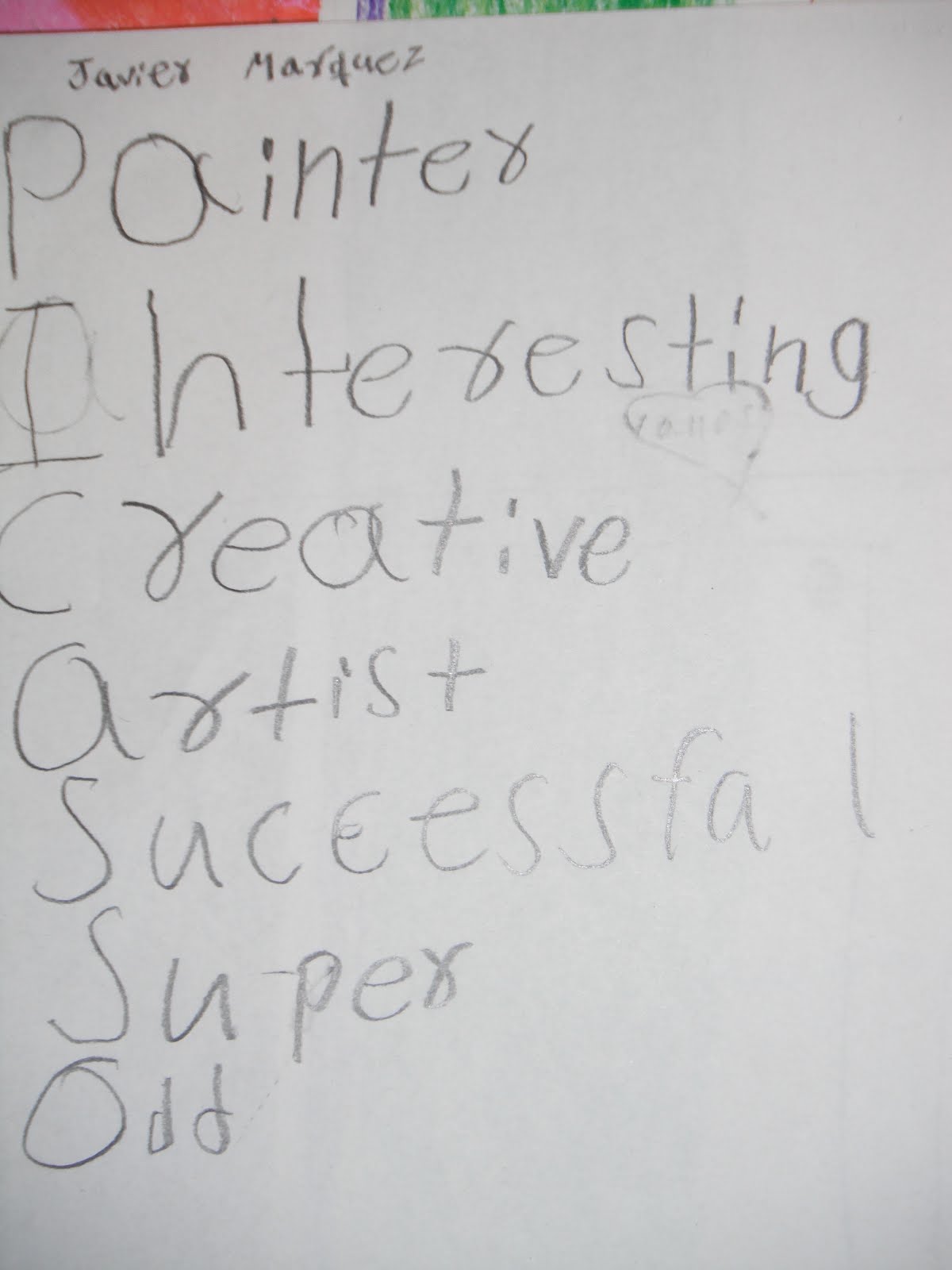
In the final class of the unit, the students were asked to "Wrap It Up." A few of them took that literally and as they made their comic strips about what we did as a class, they used 'wrap it up' day represented by presents. I kind of love these kids. The acrostic poems were a bit trickier because of their lack of spelling knowledge and their desire to input random words that happen to start with the letter. So it ended up being a poetry lesson as well.


Thursday, February 9, 2012

A Visit to Hamilton Elementary

We recently had the opportunity to visit Ms. Schick's classroom at Hamilton Elementary. We sat down for a while after school to talk about her studio space and how her students interact with it. Here are some excerpts from that conversation.


"I wanted a class that was sort of homey. Kids probably spend more time here than they do at home. I think it’s important. Also, for art, if you’re in a sterile environment or space, it’s not creative. It’s not inspiring." 


Let’s start with the paint table. How does it function?
"Well, like today, we were drawing with oil pastels and I didn’t want to just put the paint on the table because kids will just start painting. Painting is too much fun. I had everything set up over there. And then when they raised their hand, I would look at their work and then they could go get the paint. So, yeah, kids should be able to get their own things and put them away and not be waited on."


"That’s the supply table. That’s where the markers, glue, scissors, drawing books are. They really like how-to drawing books. When they are done with an activity, they can go get a how-to draw book. Kids really like those and I think it can really build your confidence in drawing."


I’m impressed with how many supplies you have.
"I’m a pretty good borrower and stealer. And, one of the moms in this arts group, said 'we all have wish lists, right?' So, she said let’s put a bin in the hallway, so people can donate. People always want to give, but they don’t want to email me or they don’t know where to bring it. Now they just walk in and throw it in this bin. And it’s been overflowing with stuff, which is really nice. The bin has a list and now I have pretty much everything on the list."


"We have an art gallery here too. It’s an art gallery/café. I rotate with the other art teacher here. Every other month we each do a show. I would consider that one of the top 5 spaces. There’s this really cool installation hanging in there now." (Students created bird sculptures and placed them in the school garden. The garden installation was documented and exhibited in the café gallery. The students also exhibited the bird sculptures in a flying sequence above the café tables.)