Wednesday, May 16, 2012

Reinforcing Studio Habits in an Art Show

Mitchell Elementary Showcase of Artists
I wanted to reinforce the Studio Habits of Mind we have been working on at our Showcase of Artists. I highlighted artists who had really grown in each of the Studio Habits of Mind. I am not a fan of competition in art shows, but this is a way to honor growth and ingenuity and a way to educate the parents as well. This particular 4th grade girl worked on this Clown Tree House for 5 weeks and overcame many challenges in getting the different platforms and balconies to stand up. This is a wonderful example of engage and persist. On the roof top is a snake swimming pool complete with diving board.

This 2nd grade boy that I chose for "Envision", created a strikingly beautiful drawing of  the Titanic with a giant blue whale underneath. Each work of art includes an artist statement which you see below.


I have a letter writing station at the show. Each visitor (student, parents, teachers, community members) is asked to write a fan letter to the artist of a favorite work of art. I included the Studio Habits of Mind poster so that the vocabulary can be included in their letters. These will be sorted and delivered to the artists.

How do you include the Studio Habits in your art exhibitions?

Monday, May 14, 2012

Sample Interviewing Questions

When interviewing students you can have them refer to the specific piece of work they have made. Interview students in a quite environment without distractions. The interview can take between 15-30 minutes. Spend more time listening than talking.


1)    What materials did you use to make the artwork?

2)    What's going on in this piece of work? What are you trying to communicate?

3)    Did it turn out the way you intended it turn out? What changed?

4)    How did you solve specific problems?

5)    Did you have an image in your head before you made this work?

6)    What inspired you to make this work?

7)    Tell me step 1, step 2, step 3, step 4, step 5 of this process for making this piece. Take me from beginning when you got the assignment right to the end.  If you were to teach me how to do this, tell me what I would have to do.

8)    Other

Give students lots of space to talk. See where they want to go with talking about the piece. You can also show them photo documentation of them at work in the studio, creating their artwork. Have them look at themselves and ask what are you doing here? 


Most students don't know what they look like when they're at work. So it can be revealing for the students to see themselves. What do they wonder about their artistic process? How is making art different from the writing or scientific process? What are you doing when you're making art? This is where ART21 comes in. When students see other artists creating and connect what they are doing with their behavior they may see themselves in a different light. 

Wednesday, May 9, 2012

Muscial Table Discussion/Speed Crit

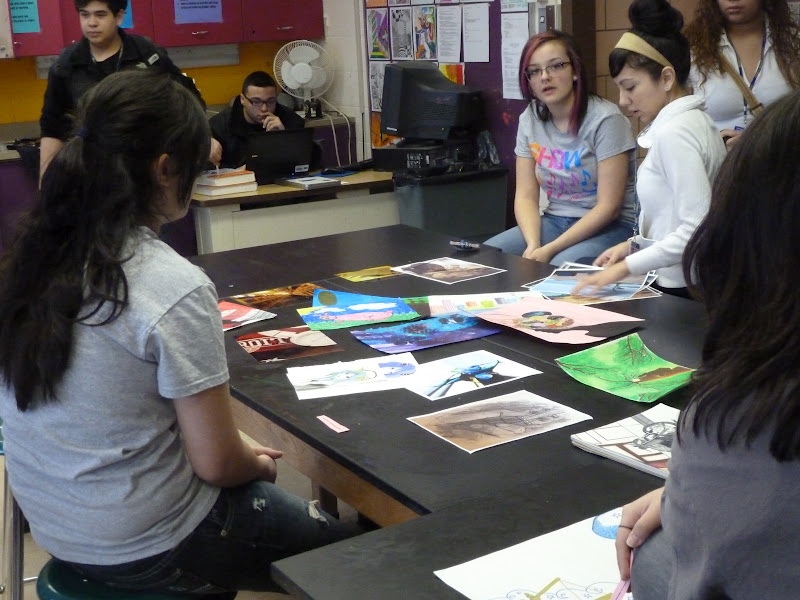
This is another way I incite students to have a lively discussion. I made it up this year based on an art-making project* I love to do and something I saw at one of the early SHoM workshops.

This works great for topic discussions (an example would be when we watched the animated movie "Persepolis", and needed to analyze and discuss it). It also works well for quick student critiques.

There are 6 stations in the classroom where students sit in groups of 4 - 6. I will put a large sheet of paper (18 x 24 or bigger) at each station.

TOPIC DISCUSSIONS:
  • In the middle of the paper I will write a prompt (6 different prompts in total, one for each station). I might also provide an art image and written prompt for art history critique.
  • Students have pencils ready.
  • They have 3 minutes to visit each station as a group. 
  • At each station, students write (on the large sheet of paper) whatever comes to mind regarding the prompt. 
  • I have them work their way around the classroom in clock-wise formation. 
  • During the 3 minute period I play music as a cue for students to write. At the end of each 3 minute section, I stop the music as a cue for students to stop writing and move to the next station. This makes it fun and like the musical chairs game.
  • Once the students have gone around the room and are back at their own station, we go into discussion mode. 
  • Students read the responses to each other and begin discussing the issue at their table. 
  • Students must find at least 5 main responses to the prompt topic and discuss them. They must have at least 2 responses that someone disagrees with, and  discuss why they disagree and what their opposing point is as a result.
  • The group "Recorder" writes down what their group discusses in a bullet list formation. 
  • The next day each group has 3 minutes to present discussion notes to the whole class. Each presentation, students in the class must have at least 1 response to challenge the group, question the group, or make a supportive remark. Often there is more than one response :). The group must counter any class feedback with an answer or explanation of their viewpoint.
  • Students receive points for group discussion/recorded notes, and separate points for presentation to class.
  • The results of this technique makes for what seems like chaos, but is really several fast-paced and animated discussions. Everyone in the class gets to participate first in a small-group setting for each topic, and then in larger group setting for all topics. 
  • I find that several things have made people forget about being self-conscious and silent in this kind of group discussion: 1) the whole thing is rather like a game and fun, 2) the fast pace puts pressure on people to come up with a response, 3) prompts give a clear indication of where I want them to start, 4) the structure provides a framework for definite but open-ended answers. 5) the grading structure insures that students must have something to present and a way to respond to the presentations (ensuring a flow of ideas and conversation), 6) since all students write on each of the prompt sheets, there is a sense of sharing information. Students get to use each others ideas to provoke further thought, 7)students become very loyal to their group and want to defend their stance to the class.
PEER CRITIQUE (I call this one Speed Crit - as in "speed dating"):
  • I like to use this for progress critique when students are half way through an artwork and need feedback. 
  • 6 stations are set up free of clutter. Each student has their artwork placed on the table with a form next to it. 
  • The form is typed by me and has 3 prompts:
    • Strengths
    • Weaknesses
    • Questions
    • In addition are two more sections: "Student response to critique", "Teacher response to critique."
  • Students must travel to each station as a group. They have 4 minutes at each station and move around the room in clock-wise formation. 
  • Music is played to let students know when to write. Music stops and restarts to let students know when to switch stations.
  • Student can choose to look at and critique any of the artworks at the table during the 4 minutes.
  • They are moving as a group, but not working together as a group. Rather they address artwork and write individually. Often though, they are making verbal comments to each other as they look at the work.
  • They must write 3 responses on the form next to the artwork. They must address the 3 prompts.
  • All artwork must have responses on the form, so if students see a blank form, they have to make sure that someone writes on it.
  • When students have visited all 6 stations, they return to their own station and artwork. They read what their classmates have written.
  • Students spend remaining time writing their own reflective response to the critique of their work. 
  • Artwork and critique forms are turned in to teacher.
  • Teacher writes a response to the critique.
  • This has proven very helpful in addressing weaknesses in the artwork. I noticed that students take a peer's constructive advice for improvement more often than listen to me tell them the same thing.
  • This can be used with the SHoM framework as a topic prompt.
I find that this process takes the fear out of speaking out loud or being honest in the critique. Responses are anonymous and therefore less pressure. Students have written concrete advice to follow that may help with the finishing of their artwork. Their own response as well as the teacher's helps the student to process the critique and implement problem-solving solutions.
 
*art projects: Mixed Media Blitz and Materials Madness. I'll describe them in another blog post.

Tuesday, May 8, 2012

Critiquing the Xanos Way

I come from a Greek family. We love to debate and discuss, loudly and passionately. I grew up this way. I raised my four children this way. At our dinner table, in the car, on the couch; there is never a lack of animated discussion about whatever topic someone might introduce. So, as a teacher, I was confounded to find students struggling to discuss an issue or critique an artwork.  Most times, groups would sit quietly while I needled them for responses. Some groups would have one or two outspoken students that did all of the work. I tried guiding a large class setting, and I did all the talking. I tried breaking them into small groups with prompts. I got the same results. So I sat down one day and asked myself "what in the world was my family doing that my students were not?"

I realized that different people in a good debate group took on different roles. The Agitator/Challenger (my Dad and my son), the Supporter (me and daughter #2), the Lecturer (me or my daughter #3), the Questioner (daughter #1). This was interesting as I had not bothered to analyze family discussions before. I figured that these roles made for some great exchanges that would go round and round and often end up in a completely different place than where we started. I probably should add that my son also fulfills the role of the Joker. You know, the one who makes fun of people when they get too serious. I chose to leave that one out of my experiment as it usually results in someone screaming in our house.

I decided to try to replicate this process, using the roles I mentioned above. My hope was to spur the students into animated and eventually complex discussions. I figured the structure provided by role playing and topic prompts would enable students to work off of each other. 

  • I teach high school and see students for 46 minutes, 5 days a week. 
  • In the classrooms, I can have 25 - 35 students in one class. They sit in groups of 4 - 6 at "stations". They make their art there and have small group discussions/projects.  Each group has a "recorder". That is a person who writes a bullet list summary of the group discussion for extra credit. 
  • I have used this particular technique to promote discussion for, 1. a debatable issue (ex. Is Graffiti Art?), 2. To critique a famous work of art, 3. To critique each others art (in progress and at the end), 4. To analyze movies or readings the class encountered. 
  • I give prompts for topic consideration depending on the issue or type of art being discussed. I might have them focus on concepts, controversy, techniques, or aesthetic success. Along with the prompts they must make certain kinds of statements. In the past I gave them a list (along with the prompts) on paper. These statements must be: a) Challenge a speaker or address a weakness in the piece, b) Support a speaker or address a strength, c) Explain what one thinks is going on (in student critique this role must be the artist), d) Raise at least two questions. I let people choose which of these statements they will make as they travel through the discussion.
  • The group starts with the Presenter/Lecturer: the student artist explains their work (or anyone can present the basic facts of the discussion topic.) After this, others in the group can Challenge, Question, or Support in any order they see fit. Anyone can also move back into Presenter mode if needed.
  • Students are told that if someone raises a challenge or asks a question, they are allowed to respond. Often a supporter chimes in at this point and others will choose sides or even raise new points. When someone responds to a challenge they have two choices a) agree that there is a weakness and then the group moves into problem-solving mode, or b) disagree and the group moves into debate mode. 
  • I found that students immediately took to having exciting and interesting discussions. While they were cautioned to keep it civil, the challengers and the questioners made people think and explain themselves. Responders often came up with interesting points that they would not bring up without a "gadfly" in the group. Supporters could bring up positive points that a Presenter might not think of and gave him/her a little back-up. People often switched roles as the discussion progressed. 
  • At first I was worried this might incite cruel comments. However, I cannot remember any time that students got mean during a discussion. Usually, the Challengers are very diplomatic. Sometimes that role is hard for anyone to choose and I have to help. We do practice giving constructive criticism/disagreement early on. I explain that the Challenger's job is to help the group problem-solve a weakness and therefore find a way to turn it into a strength.
  • After discussion, students sometimes present to the rest of the class, using the Recorder's notes. Other times, they just give the discussion notes to me and I read them. During the discussion I walk around and eavesdrop on the groups, offering help when needed.
So, this is one of the ways I get the students to talk. Unfortunately, we haven't done this once 2nd semester due to new and unusual mandates for quizzes, vocabulary, reading, writing, graphs, grammar, and math to be taught in my art class. I'm struggling just to keep the art-making happening. However, I plan to use it at least one last time with our final projects. I miss our lively group discussions. I'll bet the students do too!

When we critique, I'll video a session and post it. I hope this helps for now. 
Valerie Xanos


Kitty's notes on the development of a CPS Arts Assessment


Hi Everyone,

Two of our project teachers, Kitty Conde and Kate Schick, have been selected to work with the District to develop a visual arts assessment for students. The assessment is going to be a performance task. A committee of 5 CPS art teachers will work with Mario and the Office to determine which art standards will be the focus of the assessment. The assessment will be developed very quickly as the committee has until June 1st to create a draft assessment tool. June 1st to mid June is the testing of the tool. July is the period of revising the tool. The tool will be need to ready for use in the fall of 2012. 

The committee will also determine which grade levels will be assessed and has been given guidelines for developing the assessment. Kate, Elyn and Beth reviewed the guidelines for creating the assessment last Wednesday night at the Chicago Teachers' Center. Thanks Beth and Elyn for coming out. We all agreed that the template we saw lacked a reflection piece for students to describe their process for creating work. 

In preparation for meeting with the CPS committee Kitty has been in contact with Lois via a phone conversation. Below is an update from Kitty about their conversation. Please see the link to the performance assessment developed in England that Lois shared with Kitty. This particular assessment can be a model for the District incorporating both a performance task and a reflective practice piece. 

Kitty's notes:

Lois and I had a great conversation about assessment for Chicago. Here's a list of topics we discussed.
1) She steered me toward the work of Richard Kimbel and Kay Stables of the University of London, Goldsmiths. This performance assessment asks students to design a product. The assessment measures  various stages of design development. For example step 1-  Develop idea, etc.


Click on Assessing Design Innovation to read the document. 

2) We also talked about the idea of the three dispositions that Lois often references, including: skill, inclination and alertness as being important ways to measure student arts learning. If we are interested in an assessment that includes students ability to reflect on their practice we need to look at inclination. 

3) We talked about the idea of  choosing some of the habits, we looked at envision, observe, develop craft and reflect. The assessment should include a) how teachers reflect on students work, b)process skills- finding, developing, refining, finishing, and c)having an idea, growing an idea, and proving an idea.

4) Finally, she suggested we look at Arts Propel and their idea of a process portfolio assessment.

Kitty

Back to Kate's voice. We would like to send a letter to Mario and the Office from our group supporting the importance of having a reflective piece in the assessment. Matt and I will draft a letter that you can all review. We'll send something out by the end of the week. This process is happening very quickly. Please post comments and questions on the blog so we can have a conversation about this very important assessment. 

Thanks,
Kate

Tuesday, April 24, 2012

SHoM and Student/Teacher Performance Evaluations

All of us at CPS are thinking about what our teacher evaluations will be like next year. We will now be evaluated based on student performance.  These evaluations determine who keeps jobs and which programs are cut. Of course, we have no clue what that process is, yet must improve and develop curriculae to survive said process.
So many questions....
How will student performance be measured? What rubrics will be used? How do we measure data that is not only quantitative but also QUALITATIVE? How do we balance the numbers-driven goals of CPS and the experiential process we know works in the Art Studio? How can student performance be measured in a way to show the VALUE of art teacher performance and our own effectiveness beyond student attendance, grades, and core subject test scores? I am thinking of music, theater, and dance teacher evaluations in addition to the visual arts.

We at CPS need to be sure that the way we are evaluated reflects the way we need to teach. Our curriculum will have to respond to the ways student performance will be measured in addition to the way teacher performance will be measured. I don't know about you, but we are all a nervous wreck here at Curie. It is hard to develop a curriculum without the slightest idea of what those rubrics will be. Not to mention working under the threats made about what happens if we (and our students) don't perform according to the unknown rubric.

So I have been asking questions about WHO is developing these student and teacher evaluations. That same day I got some answers. There is a group being formed by CPS to work on it. Cool, let's get involved! Let's make sure art, music, theater, and dance teachers are on that committee.

Of course I couldn't help but think about how SHoM can play into this process. I have had such success at using this program for the first time this year. I will continue to use it. I wrote to Kate asking how can the data collection developed through SHoM help in our quest to evaluate art students and teachers fairly. She asked me to put these questions on the blog.

So here you are. What will we do? I hope to be part of the conversation and not just  a victim to what is decided for next year. I hope to be able to make use of what we have all learned this year for years to come. I hope to lessen my fear of the impending evaluation process, knowing that some of us from SHoM were part of the fair development of rubrics. We all want  to measure our own effectiveness without sacrificing the experiential quality of our instruction. How can we do this? I put this question out there... help.

Valerie Xanos

Thursday, April 19, 2012

Tree Paintings


The First Graders at Pershing East Magnet School have been observing trees this school year. This is an attempt to create a long-term science study relevant to each grade/ability level. These longitudinal studies allow studies a chance to observe one specific part of nature over the school year to develop observational skills and develop pattern recognition. The art benefit is the more students observe something, the more details they notice. Their sharpened observations will lead to better artwork, especially in their focused study.
We have drawn trees with pencils, we have photographed trees, we have printed trees, we have painted with both water color and acrylic.
Here are some samples from our acrylic paintings. We read, Sky Tree, by Thomas Locker for inspiration:

Tuesday, April 17, 2012

Critique Session at Kennedy High School

Matt Dealy, project manager for the Studio Thinking and American Art project, recently observed Ms. Barron's class at Kennedy High School. He witnessed a very interesting critique session and asked Ms. Barron these follow up questions.

Where did you discover this Critique process?
Deborah and I were introduced to some of the critique questions at a MCA workshop using a dialogue called, Asking Art 10 Questions. I also used 13 Ways of Looking at a Blackbird to generate other conversational, critique questions. We generated a list of questions which I printed and cut into strips. Students randomly selected a question from a cup as they entered the classroom, laid out their artwork and then engaged in dialogue utilizing the questions as their catalyst. I created this process on my own based from past experience leading critiques.
What drew you to it? What are its strengths?
I enjoy the idea that students receive a unique question and get to select a piece of work to discuss. I also like that the pressure to generate their own conversations is removed and students have a prompt to which they can respond. The strength of this process is that all the artworks on the table were discussed and all students had an opportunity to speak. This is different from past critiques in that typically the same group of students will participate and their conversation can be a bit simplistic, such as "That's cool" or "That's cute" or "I like it because...". The prompts added variety and diversity to our conversation in that we were not focused solely on the subject matter or the principles or elements of design.
 Can you briefly describe the steps/process?
1. Create general questions.
2. Distribute those questions randomly.
3. Begin conversation by modeling how a student might discuss a piece of art using the questions.
4. Call students using a roster to ensure all students participate.
5. Facilitate dialogue to make the critique a conversation.

How could you improve it?
I could improve the process by adding more questions to the bucket for greater variety. Though, it was interesting to see how two students might respond to the same prompt using different artworks. It offered perspective and a level of engagement that was unexpected.


How could you include Studio Thinking?
In the future I will create a series of critique questions utilizing the Studio Habits in order for students to discuss their own work in a group setting. I would most likely use the same process as this critique, but students would have a unique entry into a dialogue about their art-making process.

Thursday, April 5, 2012

Preparing LPHS Art I Students for Studio Thinking

We are piloting Studio Thinking in two of our elective courses (Mixed Media and Drawing & Painting), and introducing the language in AP and IB Art this year. The intent is to have all art students working with Studio Thinking for next school year as we have a school-wide ILT focus on Critical Thinking.

Our LPHS art students are acclimated to writing in the art room. They have always completed a variety of different types of writing while in art classes: critiques, essays, compare/contrast, investigation/sketchbook assignments, project proposals, research papers, artist statements, self-reflections and self-evaluations, etc. They understand that writing is part of learning about, from and through art.

I have often found it a challenge to teach Art I/early high school students to reflect on the project criteria that ties to the objective(s) of a specific lesson. Therefore, I have been easing them into this process through the use of a revised Art I rubric that utilizes Studio Thinking prompts to help them focus on their work process in relation to the project objectives and criteria. So far it has been quite successful, and I anticipate that the Art I students moving into electives next year will be able to easily transition into the the language having seen and reflected on the SHoM prompts in Art I this year. I also anticipate that with the introduction of the SHoM language for Art I next year, their reflective writing will only improve.

Rubric uploaded to Google Docs.


LPHS Mixed Media: Personal Narrative Collage

We began the project by looking at the season one Art 21: Identity episode followed by a series of individual and group "Close Reads" of Outsider Collage artists such as Henry Darger, Tony Fitzpatrick, Holli Schorno, and Jose Felipe Consalvos to name a few. The students were then charged with developing their own collages based on the project guidelines and the artist(s) that inspired them.


I developed a project handout format for the Mixed Media art students to begin associating SHoM language with routine lesson procedures in the classroom as they develop their individual artistic processes and styles. I aligned the habits with various lesson procedures in the instructional handout so that the students can more easily associate their work processes with the habits while making, reflecting and self-evaluating. The project handout and the rubric have been uploaded to Google Docs. I have included an excerpt of each here:

Concept: (Express, Understand Art World: Domain & Communities) Choose a topic or theme that is of interest to you, and that is important or relevant to you in your life at this time. Your chosen theme/topic should say something about you and/or your personality and interests. Your theme could be related to any or all of the following categories: Personal, political, social, spiritual and everything in between!

from procedure section:

  • Begin planning your collage on large paper. (Observe, Stretch & Explore, Engage & Persist) You may alter the size/shape of the background paper, but your final collage may not be smaller than 9” x12” in size. It may be orientated either landscape or portrait.
  • When finished, choose 4 Studio Habits to reflect on including Understand Art World: Domain & Communities. Consider process, content and technique! (Reflect: Question & Explain and Evaluate)

Media Use & Technique:

Develop Craft

Engage & Persist

Stretch & Explore


*Little/no attempt to use mixed media processes (1 medium only) to create collage

*Composition not considered

*Applies at least 2 mixed media processes to create collage

*Composition needs improvements


*Adequately applies 3 mixed media materials, processes to collage

*Evaluates composition for improvements

*Successfully applies 3 or more mixed media materials, processes to collage

*Critically evaluates composition for improvements and makes adjustments

_____

• My work looks polished and well crafted because

• When I ran into difficulty, the way I solved the problem was

• I tried something I had never done before when I


I was very pleased with the results. I have found it to be very difficult to teach "sophisticated" collage composition techniques to high school students. This group exceeded my expectations with both product and their thoughtful reflections on the process and connections between their ideas and contemporary artists and techniques. They all really loved this experience!

Wednesday, April 4, 2012

Pre/Post assessment of SHoM

I created a simple pre/post assessment of SHoM. I recently had my Art 1 students complete the top part. At the end of the year, they will complete the bottom part. Next year, this is something that I will do the first week of school and then complete at the end of the year.

After break, students will reflect on a sculpture project by using the lens: Engage & Persist. I am working on a think sheet to give them. This is the first 3-D project they have done. Students had to make the transition from thinking to 2-D to thinking in 3-D. Look for photos of our towers & reflections after spring break.


I've started a Pinterest Board about Studio Thinking.

I found these images that show ShoM and ways to integrate them into other curriculum areas.

Cheryl

Sunday, March 18, 2012

Learning to Observe

Kindergarten and 1st Grade students are learning to observe through creating contour drawings. I worked in a small group with students observing details on plastic toy animals. Students noted size differences, color placement, and shape. Some students asked to envision where that animal might be outside.

1st Grade connected their animal drawings to Lascaux Cave paintings, which they are learning about in social studies. They understood how the first artists created records of the things they saw and were important to them and their society.


Monday, March 5, 2012

Interviewing Ilene - a student artist from Garvey


Listen to an audio interview with Ilene Selgado, a 6th grade student from Garvey Elementary School (Chrissy Gray Rodriquez's school).

We wanted to interview Ilene about a specific self-portrait. I watched Ms. Gray lead a critique session with her students. In the critique Ms. Gray referenced Ilene's piece and shared with another class how Ilene had really stretched and gone beyond by adding specific details to the portrait. I suggested to Ms. Gray that we interview her to learn more about her decision-making. This is an excerpt.

Some of the members of our Studio Thinking team are going to interview 1-3 students in their classes to learn more about their creative process. I will share a transcription of this interview with Ilene and provide some suggestions for interviewing students in the next blog entry. Stay tuned.