All of us at CPS are thinking about what our teacher evaluations will be like next year. We will now be evaluated based on student performance. These evaluations determine who keeps jobs and which programs are cut. Of course, we have no clue what that process is, yet must improve and develop curriculae to survive said process.
So many questions....
How will student performance be measured? What rubrics will be used? How do we measure data that is not only quantitative but also QUALITATIVE? How do we balance the numbers-driven goals of CPS and the experiential process we know works in the Art Studio? How can student performance be measured in a way to show the VALUE of art teacher performance and our own effectiveness beyond student attendance, grades, and core subject test scores? I am thinking of music, theater, and dance teacher evaluations in addition to the visual arts.
We at CPS need to be sure that the way we are evaluated reflects the way we need to teach. Our curriculum will have to respond to the ways student performance will be measured in addition to the way teacher performance will be measured. I don't know about you, but we are all a nervous wreck here at Curie. It is hard to develop a curriculum without the slightest idea of what those rubrics will be. Not to mention working under the threats made about what happens if we (and our students) don't perform according to the unknown rubric.
So I have been asking questions about WHO is developing these student and teacher evaluations. That same day I got some answers. There is a group being formed by CPS to work on it. Cool, let's get involved! Let's make sure art, music, theater, and dance teachers are on that committee.
Of course I couldn't help but think about how SHoM can play into this process. I have had such success at using this program for the first time this year. I will continue to use it. I wrote to Kate asking how can the data collection developed through SHoM help in our quest to evaluate art students and teachers fairly. She asked me to put these questions on the blog.
So here you are. What will we do? I hope to be part of the conversation and not just a victim to what is decided for next year. I hope to be able to make use of what we have all learned this year for years to come. I hope to lessen my fear of the impending evaluation process, knowing that some of us from SHoM were part of the fair development of rubrics. We all want to measure our own effectiveness without sacrificing the experiential quality of our instruction. How can we do this? I put this question out there... help.
Valerie Xanos

Tuesday, April 24, 2012


Thursday, April 19, 2012
Tree Paintings


The First Graders at Pershing East Magnet School have been observing trees this school year. This is an attempt to create a long-term science study relevant to each grade/ability level. These longitudinal studies allow studies a chance to observe one specific part of nature over the school year to develop observational skills and develop pattern recognition. The art benefit is the more students observe something, the more details they notice. Their sharpened observations will lead to better artwork, especially in their focused study.
We have drawn trees with pencils, we have photographed trees, we have printed trees, we have painted with both water color and acrylic.
Here are some samples from our acrylic paintings. We read, Sky Tree, by Thomas Locker for inspiration:
Tuesday, April 17, 2012
Critique Session at Kennedy High School
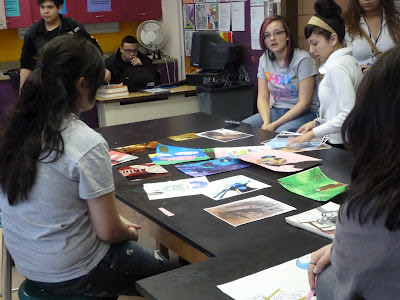
Matt Dealy, project manager for the Studio Thinking and American Art project, recently observed Ms. Barron's class at Kennedy High School. He witnessed a very interesting critique session and asked Ms. Barron these follow up questions.
Where did you discover this Critique process?

Where did you discover this Critique process?
Deborah and I were introduced to some of the critique questions at a MCA workshop using a dialogue called, Asking Art 10 Questions. I also used 13 Ways of Looking at a Blackbird to generate other conversational, critique questions. We generated a list of questions which I printed and cut into strips. Students randomly selected a question from a cup as they entered the classroom, laid out their artwork and then engaged in dialogue utilizing the questions as their catalyst. I created this process on my own based from past experience leading critiques.

What drew you to it? What are its strengths?
 Can you briefly describe the steps/process?


I enjoy the idea that students receive a unique question and get to select a piece of work to discuss. I also like that the pressure to generate their own conversations is removed and students have a prompt to which they can respond. The strength of this process is that all the artworks on the table were discussed and all students had an opportunity to speak. This is different from past critiques in that typically the same group of students will participate and their conversation can be a bit simplistic, such as "That's cool" or "That's cute" or "I like it because...". The prompts added variety and diversity to our conversation in that we were not focused solely on the subject matter or the principles or elements of design.
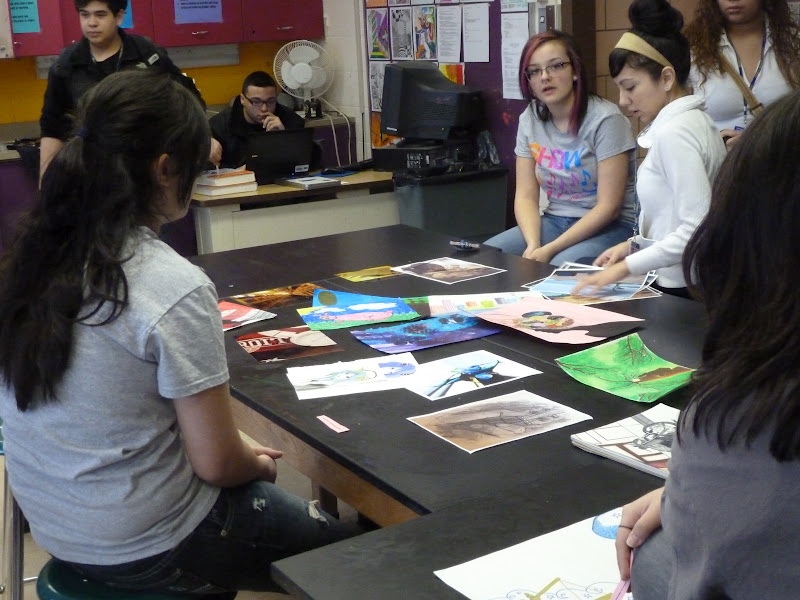
1. Create general questions.
2. Distribute those questions randomly.
3. Begin conversation by modeling how a student might discuss a piece of art using the questions.
4. Call students using a roster to ensure all students participate.
5. Facilitate dialogue to make the critique a conversation.


How could you improve it?


I could improve the process by adding more questions to the bucket for greater variety. Though, it was interesting to see how two students might respond to the same prompt using different artworks. It offered perspective and a level of engagement that was unexpected.


How could you include Studio Thinking?
In the future I will create a series of critique questions utilizing the Studio Habits in order for students to discuss their own work in a group setting. I would most likely use the same process as this critique, but students would have a unique entry into a dialogue about their art-making process.
Thursday, April 5, 2012
Preparing LPHS Art I Students for Studio Thinking
We are piloting Studio Thinking in two of our elective courses (Mixed Media and Drawing & Painting), and introducing the language in AP and IB Art this year. The intent is to have all art students working with Studio Thinking for next school year as we have a school-wide ILT focus on Critical Thinking.

Our LPHS art students are acclimated to writing in the art room. They have always completed a variety of different types of writing while in art classes: critiques, essays, compare/contrast, investigation/sketchbook assignments, project proposals, research papers, artist statements, self-reflections and self-evaluations, etc. They understand that writing is part of learning about, from and through art.
I have often found it a challenge to teach Art I/early high school students to reflect on the project criteria that ties to the objective(s) of a specific lesson. Therefore, I have been easing them into this process through the use of a revised Art I rubric that utilizes Studio Thinking prompts to help them focus on their work process in relation to the project objectives and criteria. So far it has been quite successful, and I anticipate that the Art I students moving into electives next year will be able to easily transition into the the language having seen and reflected on the SHoM prompts in Art I this year. I also anticipate that with the introduction of the SHoM language for Art I next year, their reflective writing will only improve.
Rubric uploaded to Google Docs.

LPHS Mixed Media: Personal Narrative Collage
We began the project by looking at the season one Art 21: Identity episode followed by a series of individual and group "Close Reads" of Outsider Collage artists such as Henry Darger, Tony Fitzpatrick, Holli Schorno, and Jose Felipe Consalvos to name a few. The students were then charged with developing their own collages based on the project guidelines and the artist(s) that inspired them.


I developed a project handout format for the Mixed Media art students to begin associating SHoM language with routine lesson procedures in the classroom as they develop their individual artistic processes and styles. I aligned the habits with various lesson procedures in the instructional handout so that the students can more easily associate their work processes with the habits while making, reflecting and self-evaluating. The project handout and the rubric have been uploaded to Google Docs. I have included an excerpt of each here:
Concept: (Express, Understand Art World: Domain & Communities) Choose a topic or theme that is of interest to you, and that is important or relevant to you in your life at this time. Your chosen theme/topic should say something about you and/or your personality and interests. Your theme could be related to any or all of the following categories: Personal, political, social, spiritual and everything in between!
from procedure section:
- Begin planning your collage on large paper. (Observe, Stretch & Explore, Engage & Persist) You may alter the size/shape of the background paper, but your final collage may not be smaller than 9” x12” in size. It may be orientated either landscape or portrait.
- When finished, choose 4 Studio Habits to reflect on including Understand Art World: Domain & Communities. Consider process, content and technique! (Reflect: Question & Explain and Evaluate)
| Media Use & Technique: Develop Craft Engage & Persist Stretch & Explore | *Little/no attempt to use mixed media processes (1 medium only) to create collage *Composition not considered | *Applies at least 2 mixed media processes to create collage *Composition needs improvements | *Adequately applies 3 mixed media materials, processes to collage *Evaluates composition for improvements | *Successfully applies 3 or more mixed media materials, processes to collage *Critically evaluates composition for improvements and makes adjustments | _____ |
| • My work looks polished and well crafted because • When I ran into difficulty, the way I solved the problem was • I tried something I had never done before when I | |||||


I was very pleased with the results. I have found it to be very difficult to teach "sophisticated" collage composition techniques to high school students. This group exceeded my expectations with both product and their thoughtful reflections on the process and connections between their ideas and contemporary artists and techniques. They all really loved this experience!
Wednesday, April 4, 2012
Pre/Post assessment of SHoM
I created a simple pre/post assessment of SHoM. I recently had my Art 1 students complete the top part. At the end of the year, they will complete the bottom part. Next year, this is something that I will do the first week of school and then complete at the end of the year.
After break, students will reflect on a sculpture project by using the lens: Engage & Persist. I am working on a think sheet to give them. This is the first 3-D project they have done. Students had to make the transition from thinking to 2-D to thinking in 3-D. Look for photos of our towers & reflections after spring break.
I've started a Pinterest Board about Studio Thinking.
I found these images that show ShoM and ways to integrate them into other curriculum areas.
Cheryl
Wednesday, March 28, 2012


Sunday, March 18, 2012
Learning to Observe
Kindergarten and 1st Grade students are learning to observe through creating contour drawings. I worked in a small group with students observing details on plastic toy animals. Students noted size differences, color placement, and shape. Some students asked to envision where that animal might be outside.
1st Grade connected their animal drawings to Lascaux Cave paintings, which they are learning about in social studies. They understood how the first artists created records of the things they saw and were important to them and their society.


Monday, March 5, 2012
Interviewing Ilene - a student artist from Garvey
Listen to an audio interview with Ilene Selgado, a 6th grade student from Garvey Elementary School (Chrissy Gray Rodriquez's school).
We wanted to interview Ilene about a specific self-portrait. I watched Ms. Gray lead a critique session with her students. In the critique Ms. Gray referenced Ilene's piece and shared with another class how Ilene had really stretched and gone beyond by adding specific details to the portrait. I suggested to Ms. Gray that we interview her to learn more about her decision-making. This is an excerpt.
Some of the members of our Studio Thinking team are going to interview 1-3 students in their classes to learn more about their creative process. I will share a transcription of this interview with Ilene and provide some suggestions for interviewing students in the next blog entry. Stay tuned.
Sunday, February 26, 2012
American Art and Studio Thinking Unit Planning
Listen as two teachers from World Language High School, Little Village Lawndale Campus collaboratively plan an American art integrated unit. It's an excellent example of the support and expertise an art teacher can bring to the development of lessons in other content areas.
Teachers are using the Studio Thinking Framework as a guide and common language in the development of cross-curricular lessons/units. Check back to see documentation, process, synthesis and analysis from these units as they unfold during the next couple of months.


Monday, February 20, 2012
Lois Hetland Considers the Current Climate for Arts Education

What are some of the common trends that you see developing as you visit diverse learning environments across the country?
Downside: teacher, parent, child, and administrator frustration with and exhaustion from lack of support, lack of professional community, and lack of connections to their field as artists and art educators; fear and anger at the threat of programs being extinguished; fear and anger at the threat of having to choose between artist-teachers and teaching artists as a cost-saving issue; fear and anger at inadequate art supplies, technological access and training, teaching schedules, class sizes; teachers feeling despair, devalued, misunderstood; lower-income kids getting less arts and turning away (being turned away) from school success; misapplication and misunderstanding of research paradigms, data collection, research design (mono-method paper and pencil high-stakes testing, teaching to the test, ignoring education of the person)
Monday, February 13, 2012
Getting the inside track to Understanding the Art World and Reflection
This year I am attempting to set up a framework where art history is touched on in every grade level and when the librarian at my school showed me this book, I was very excited to use it. The second graders loved reading it with me! This book opened the door to them seeing how two artists created their work so differently.

After reading the book the first day, the students looked at a book about Picasso and saw some of his portraiture. They worked on drawings using both a forward look and the profile of a face and drew and colored (if they had time). I helped them by pointing how how strange Picasso chose to draw and had them practice saying, "Weird is GOOD!" so that they wouldn't get hung up on 'right and wrong' or perfection. One of the things I had experienced with these second graders is the dreaded "Eraser Addiction" that wastes all 40 minutes of my classtime. The drawings were pretty great (as you'll see below).
The next class we spent some time looking at a Matisse book and talked about how he liked to use big shapes and how his shapes were similar but not all exactly the same. I focused again on having things not be 'perfect.' Also, I had them use a new medium, oil pastels. They were able to color over other colors with ease, which made it easier for those who had trouble staying in the lines. The students were able to create art without feeling nervous of making mistakes.


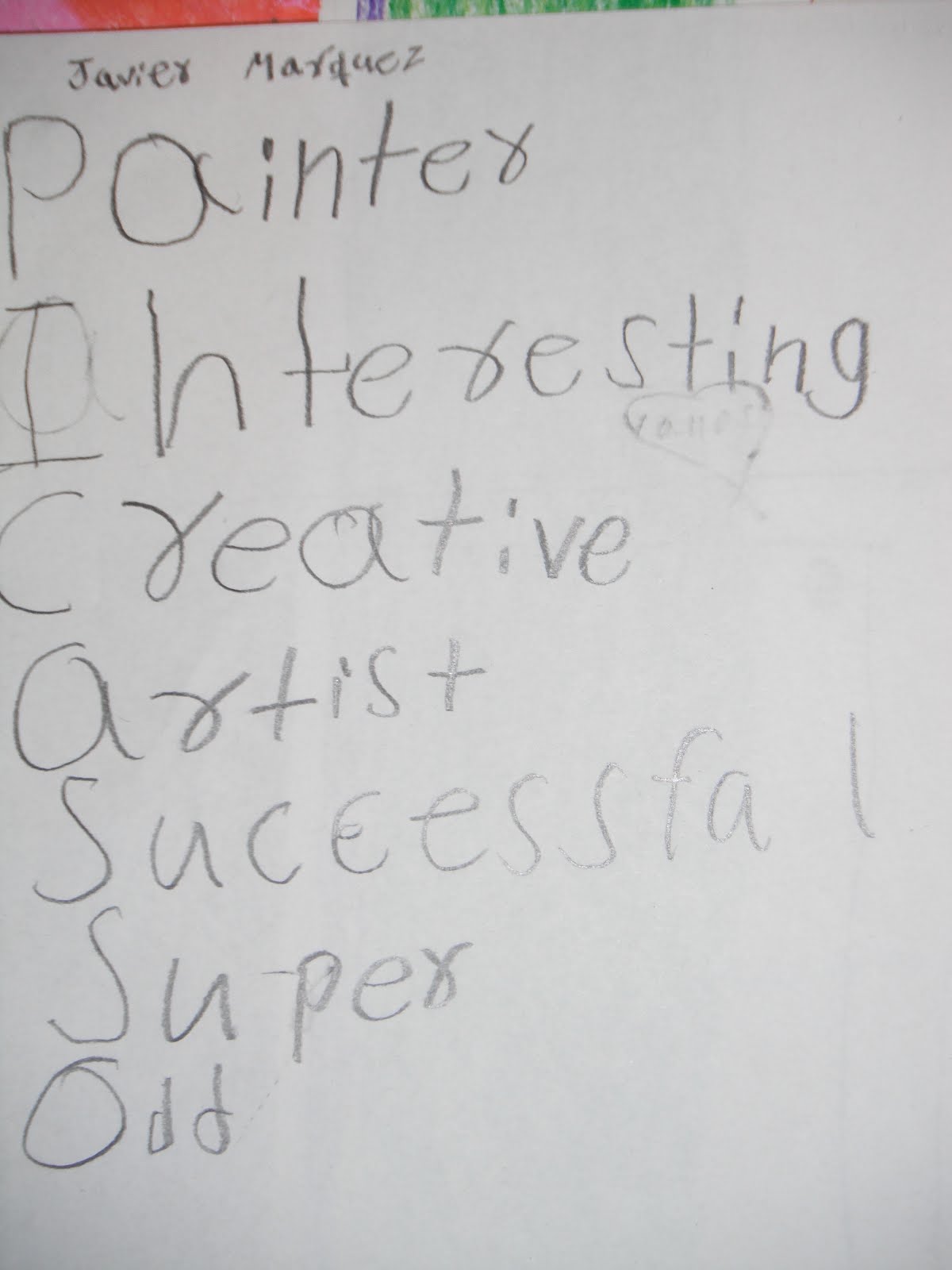
 In the final class of the unit, the students were asked to "Wrap It Up." A few of them took that literally and as they made their comic strips about what we did as a class, they used 'wrap it up' day represented by presents. I kind of love these kids. The acrostic poems were a bit trickier because of their lack of spelling knowledge and their desire to input random words that happen to start with the letter. So it ended up being a poetry lesson as well.



Subscribe to:
Posts (Atom)