Showing posts with label Studio Structures. Show all posts

Tuesday, April 17, 2012

Critique Session at Kennedy High School

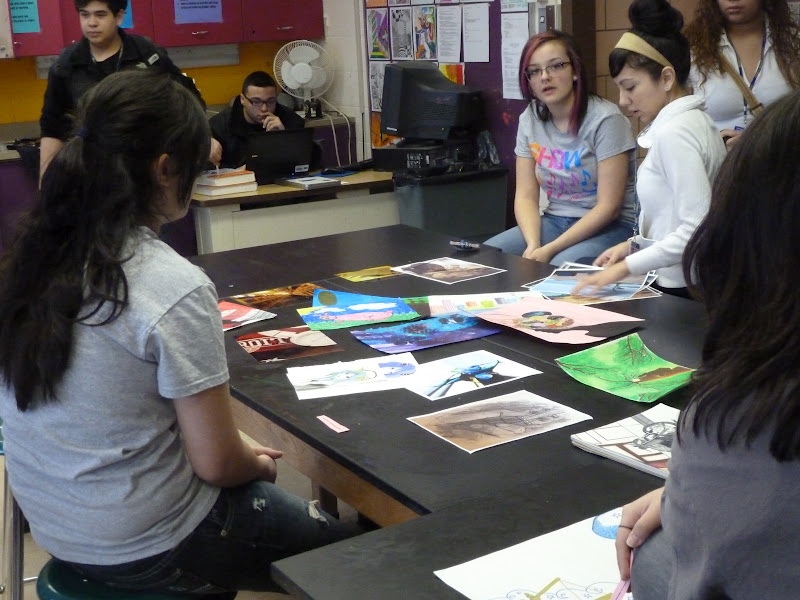
Matt Dealy, project manager for the Studio Thinking and American Art project, recently observed Ms. Barron's class at Kennedy High School. He witnessed a very interesting critique session and asked Ms. Barron these follow up questions.

Where did you discover this Critique process?
Deborah and I were introduced to some of the critique questions at a MCA workshop using a dialogue called, Asking Art 10 Questions. I also used 13 Ways of Looking at a Blackbird to generate other conversational, critique questions. We generated a list of questions which I printed and cut into strips. Students randomly selected a question from a cup as they entered the classroom, laid out their artwork and then engaged in dialogue utilizing the questions as their catalyst. I created this process on my own based from past experience leading critiques.
What drew you to it? What are its strengths?
I enjoy the idea that students receive a unique question and get to select a piece of work to discuss. I also like that the pressure to generate their own conversations is removed and students have a prompt to which they can respond. The strength of this process is that all the artworks on the table were discussed and all students had an opportunity to speak. This is different from past critiques in that typically the same group of students will participate and their conversation can be a bit simplistic, such as "That's cool" or "That's cute" or "I like it because...". The prompts added variety and diversity to our conversation in that we were not focused solely on the subject matter or the principles or elements of design.
 Can you briefly describe the steps/process?
1. Create general questions.
2. Distribute those questions randomly.
3. Begin conversation by modeling how a student might discuss a piece of art using the questions.
4. Call students using a roster to ensure all students participate.
5. Facilitate dialogue to make the critique a conversation.

How could you improve it?
I could improve the process by adding more questions to the bucket for greater variety. Though, it was interesting to see how two students might respond to the same prompt using different artworks. It offered perspective and a level of engagement that was unexpected.


How could you include Studio Thinking?
In the future I will create a series of critique questions utilizing the Studio Habits in order for students to discuss their own work in a group setting. I would most likely use the same process as this critique, but students would have a unique entry into a dialogue about their art-making process.

Friday, December 2, 2011

Studio Structures - Students at Work

Students at Work is one of the studio structures within the Studio Thinking Framework.We've been visiting your classrooms to observe the physical studio space in your building, see students at work and witness your practice. We feel very lucky to be invited in. Thank you for opening your doors and thank you to your students for letting us ask questions and take pictures.


Catherine Tanner: "Everyone needs a white piece of paper. This is going
to be your little sketch book. You can look out the window at the trees"


Intense observation. This kindergarten boy in Catherine Tanner's class
stared intently at this butterfly for a very long time. He was enthralled.


There is remarkable concentration and focus going on at Lincoln Park
H.S. in both Beth's and Didi's classrooms. Students are disciplined
and honest as they provide feedback to each other in an informal way.


Beth walks around the room and talks to students about their work. Beth says,

"Remember you want to have your ink bottles up in front of you. I know it’s
hard so practice as much as you can. By tomorrow we’re going to phase 2.
You’ve got time to experiment. If you need to spread out, you can. Like I said,
practice as much as possible."


A student says to another student at their table

Student: "Your hair is not like that. You’re more smiley than that.
It’s looking less and less like you. Your eyebrows don’t go like
this." (she points downward)
Beth: "Take time to look at your distinguishing features."


Didi leans in to examine an image.
Didi: "I need a bit more information. What is it that you
want to show?"
Didi: "A sky scrapper?"
Student: "Oh, I can go up."
Didi: "You might have to glue this on to make it stronger."


Students at work in Didi's Studio Drawing class. Students are
creating 20 different cards based on a theme.

Monday, October 31, 2011

Professional Photographer in your classroom?


Hi STAA Teachers,

A friend and wonderful photographer Orin Zyvan is available to photograph your student artists at work. He just documented my friend Steve Musgrave in his studio and created beautiful shots of the artist at work.

I asked him if he would photograph students in the public schools at work and he said yes (it's free). He would like to keep some photos for his portfolio so families and students have to be o.k. with that. Otherwise the beautiful photos will be for you and your students to look at to better understand the artistic process.

Let me know if you're interested. He's leaving town in about a month so time is of the essence.

Thanks,
Kate

Wednesday, October 12, 2011

Your impressions of Lois' Visit

We wanted to hear from you about Lois' presentation.
As per Lois' recommendation for Professional Learning Community she says:

"Stay in regular touch, virtually and f2f, with explicit intentions (make your goals public) and with actions linked directly to those intentions (focus) and with regular checks to see what you’re learning and how, by comparing what you’re doing and learning to your intentions!"

Here are some questions to guide your thoughts. Feel free to add other thoughts.
  1. What were your impressions of her presentation?
  2. Did you have an inclination to try anything in your classroom based on the presentation?
  3. What are you still curious about?


Monday, September 26, 2011

The Centipede's Dilemma

In a recent visit to Berwyn, Lois Hetland spoke with art teacher, Andrea Siegler, about applying the Studio Thinking Framework to her own practice. Within this conversation, Hetland references a poem called, "The Centipede's Dilemma" to illustrate the painfulness of getting stuck in one's purpose.

A centipede was happy quite,
Until a frog in fun
Said, "Pray, which leg comes after which?"
This raised her mind to such a pitch,
She lay distracted in the ditch
Considering how to run.
-Anonymous


Tuesday, September 20, 2011

Lois Hetland comes to Chicago


We're excited to announce that Lois Hetland, co-author of the Studio Thinking: The Real Benefits of a Visual Arts Education will be in Chicago on Oct. 6th from 4-7 p.m. at the Chicago Teachers' Center to present the Studio Thinking framework. To RSVP contact everyarteverychild@gmail.com. All CPS art teachers are invited to attend.