Did I post about this yet?
I have a blog where I keep track of brainstorming, ideas for art, ideas for curriculum, improving teaching practice etc. I keep this because
A. I keep losing slips of paper where I'd write "brilliant" ideas (see Seinfeld episode, lost joke)
B. Can access anywhere and want to keep track and develop ideas, flashes of inspiration
C. Documents how much freaking time teachers work outside of the classroom (especially the obsessive ones)
I'd love for feedback. You can feel free to make use of my brainstorming... but I'd love to hear your ideas or inspirations in response...
http://teachersafterhours.blogspot.com/

Showing posts with label assessment. Show all posts
Showing posts with label assessment. Show all posts
Wednesday, October 2, 2013


Does Anyone have a SHoM Intro powerpoint?
Has anyone created a powerpoint that explains SHoM?
Gives definition of each habit?
Photos that are examples of habit?
Student Reflective Writing for each habit?
I want to train students more effectively. If someone already has it, that would be awesome!
Are we still putting that kind of stuff on Google Drive? Or on blog?
Gives definition of each habit?
Photos that are examples of habit?
Student Reflective Writing for each habit?
I want to train students more effectively. If someone already has it, that would be awesome!
Are we still putting that kind of stuff on Google Drive? Or on blog?
Friday, September 20, 2013
Close Read Experience
Hi, just wanted to share experiences with CR so far.
After I showed them the powerpoint on CR strategy (I taught the steps then we practiced it as a group), I had students practice on their own looking at an image I provided. I included some artist background with the image to help with the context step. Later I have students do their own research regarding the artist.
They looked at an Elizabeth Catlett image and used a form I made (both uploaded to blog).
I had them try this without any help. I was interested to see how they did on their own.
Results:
Students who are used to doing critical thinking in other classes did great (as expected). The IB students handled it like pros. They learned the strategy and were able to apply their usual critical thinking skills to analyze the artwork very well. I found their responses to be very enlightening. As soon as I get a chance, I will upload a few examples.
Then there were students who were interested, learned from me, but did not do this often in other classes or on own. They did "ok". They certainly attempted to think deeply and write about their analysis and understanding. I know with a bit of guidance they will easily reach a higher level of thinking. (I'll also upload a couple examples of these)
Lastly, are the students who struggled with the process. They did not read or really answer the prompts given. They wrote the most basic answer they thought I wanted without really thinking about it. Sometimes they didn't answer at all. Perhaps did not listen or understand when I taught the process by example. These students all told me that they have not had experience in other classes doing this type of work and were frustrated at the level of focus I was asking of them. I can see they will need the most help and guidance learning to think and respond critically. Most of them were freshmen and sophomores. (also provide some ex)
So, I now want to think about the best way to facilitate improvement. Obviously repetition. I'm thinking of arranging heterogenous groups, with a student leader (higher level), a couple of mid-level students, and a couple struggling. If they work together on a few CR, perhaps peer teaching will make a difference.
What do you all think?
Thursday, August 29, 2013
Close Read
I used the Close Read format extensively last year. I really like it and enjoyed the Context aspect of it. Before that I had used a more traditional and complex critiquing format (similar to Art Talk).
I've decided to combine the two.
What I like:
What I don't like:
I've decided to combine the two.
What I like:
- Close Read works great for beginning students. It is simplified and it helps them break down the critiquing structure into bits that are easy to do. Gives them the confidence to find "clues" and make inferences. I tell them it's like being a detective.
- Context step helps them make sure they do research on artist, background and make connections. Love it!
- Not too intimidating for 1st year art students in HS. They tend to freak out if we ask for formal analysis as they do not yet have enough experience using elements and principles to create. That comes with time, to have the vocabulary and experience making decisions.
What I don't like:
- The judgment is way too vague, only referring to whether one likes the piece or not. An artistic judgment should include thoughtful responses and analysis of artist's intentions and decisions. Especially to use CR for student work, they need to think about their strengths and weaknesses regarding those decisions in order to make improvements.
- I've added prompts to make a more thoughtful judgment.
- Missing a formal analytical step crucial to more advanced students. This step should address the formal qualities of an artwork, decisions artist made about composition, elements, principles, etc.
- I would add a step for advanced students.
So, with a little tweaking, I am continuing with CR. The cool thing is, it's ALL THE RAGE in CPS. Mentioned in connection to CCSS and CPS preferred way for us to do units. CPS Art programs are strongly encouraging us to use CR. So when I include it in my unit/lesson plans, it hits those points and makes evaluators happy. Will help with my own REACH evaluation.
I made a powerpoint to teach beginning students about CR. Once they get the hang of it, we use this method all year long. I've shared it with Every Art Every Child on Google docs. I don't know how to put a powerpoint on this blog. But maybe EAEC can do that? Matt?
Let me know what you guys do for critiques. I'd love to see other methods. Always learning...
Valerie
Tuesday, May 8, 2012
Critiquing the Xanos Way
I come from a Greek family. We love to debate and discuss, loudly and passionately. I grew up this way. I raised my four children this way. At our dinner table, in the car, on the couch; there is never a lack of animated discussion about whatever topic someone might introduce. So, as a teacher, I was confounded to find students struggling to discuss an issue or critique an artwork. Most times, groups would sit quietly while I needled them for responses. Some groups would have one or two outspoken students that did all of the work. I tried guiding a large class setting, and I did all the talking. I tried breaking them into small groups with prompts. I got the same results. So I sat down one day and asked myself "what in the world was my family doing that my students were not?"
I realized that different people in a good debate group took on different roles. The Agitator/Challenger (my Dad and my son), the Supporter (me and daughter #2), the Lecturer (me or my daughter #3), the Questioner (daughter #1). This was interesting as I had not bothered to analyze family discussions before. I figured that these roles made for some great exchanges that would go round and round and often end up in a completely different place than where we started. I probably should add that my son also fulfills the role of the Joker. You know, the one who makes fun of people when they get too serious. I chose to leave that one out of my experiment as it usually results in someone screaming in our house.
I decided to try to replicate this process, using the roles I mentioned above. My hope was to spur the students into animated and eventually complex discussions. I figured the structure provided by role playing and topic prompts would enable students to work off of each other.
- I teach high school and see students for 46 minutes, 5 days a week.
- In the classrooms, I can have 25 - 35 students in one class. They sit in groups of 4 - 6 at "stations". They make their art there and have small group discussions/projects. Each group has a "recorder". That is a person who writes a bullet list summary of the group discussion for extra credit.
- I have used this particular technique to promote discussion for, 1. a debatable issue (ex. Is Graffiti Art?), 2. To critique a famous work of art, 3. To critique each others art (in progress and at the end), 4. To analyze movies or readings the class encountered.
- I give prompts for topic consideration depending on the issue or type of art being discussed. I might have them focus on concepts, controversy, techniques, or aesthetic success. Along with the prompts they must make certain kinds of statements. In the past I gave them a list (along with the prompts) on paper. These statements must be: a) Challenge a speaker or address a weakness in the piece, b) Support a speaker or address a strength, c) Explain what one thinks is going on (in student critique this role must be the artist), d) Raise at least two questions. I let people choose which of these statements they will make as they travel through the discussion.
- The group starts with the Presenter/Lecturer: the student artist explains their work (or anyone can present the basic facts of the discussion topic.) After this, others in the group can Challenge, Question, or Support in any order they see fit. Anyone can also move back into Presenter mode if needed.
- Students are told that if someone raises a challenge or asks a question, they are allowed to respond. Often a supporter chimes in at this point and others will choose sides or even raise new points. When someone responds to a challenge they have two choices a) agree that there is a weakness and then the group moves into problem-solving mode, or b) disagree and the group moves into debate mode.
- I found that students immediately took to having exciting and interesting discussions. While they were cautioned to keep it civil, the challengers and the questioners made people think and explain themselves. Responders often came up with interesting points that they would not bring up without a "gadfly" in the group. Supporters could bring up positive points that a Presenter might not think of and gave him/her a little back-up. People often switched roles as the discussion progressed.
- At first I was worried this might incite cruel comments. However, I cannot remember any time that students got mean during a discussion. Usually, the Challengers are very diplomatic. Sometimes that role is hard for anyone to choose and I have to help. We do practice giving constructive criticism/disagreement early on. I explain that the Challenger's job is to help the group problem-solve a weakness and therefore find a way to turn it into a strength.
- After discussion, students sometimes present to the rest of the class, using the Recorder's notes. Other times, they just give the discussion notes to me and I read them. During the discussion I walk around and eavesdrop on the groups, offering help when needed.
So, this is one of the ways I get the students to talk. Unfortunately, we haven't done this once 2nd semester due to new and unusual mandates for quizzes, vocabulary, reading, writing, graphs, grammar, and math to be taught in my art class. I'm struggling just to keep the art-making happening. However, I plan to use it at least one last time with our final projects. I miss our lively group discussions. I'll bet the students do too!
When we critique, I'll video a session and post it. I hope this helps for now.
Valerie Xanos
Tuesday, April 24, 2012
SHoM and Student/Teacher Performance Evaluations
All of us at CPS are thinking about what our teacher evaluations will be like next year. We will now be evaluated based on student performance. These evaluations determine who keeps jobs and which programs are cut. Of course, we have no clue what that process is, yet must improve and develop curriculae to survive said process.
So many questions....
How will student performance be measured? What rubrics will be used? How do we measure data that is not only quantitative but also QUALITATIVE? How do we balance the numbers-driven goals of CPS and the experiential process we know works in the Art Studio? How can student performance be measured in a way to show the VALUE of art teacher performance and our own effectiveness beyond student attendance, grades, and core subject test scores? I am thinking of music, theater, and dance teacher evaluations in addition to the visual arts.
We at CPS need to be sure that the way we are evaluated reflects the way we need to teach. Our curriculum will have to respond to the ways student performance will be measured in addition to the way teacher performance will be measured. I don't know about you, but we are all a nervous wreck here at Curie. It is hard to develop a curriculum without the slightest idea of what those rubrics will be. Not to mention working under the threats made about what happens if we (and our students) don't perform according to the unknown rubric.
So I have been asking questions about WHO is developing these student and teacher evaluations. That same day I got some answers. There is a group being formed by CPS to work on it. Cool, let's get involved! Let's make sure art, music, theater, and dance teachers are on that committee.
Of course I couldn't help but think about how SHoM can play into this process. I have had such success at using this program for the first time this year. I will continue to use it. I wrote to Kate asking how can the data collection developed through SHoM help in our quest to evaluate art students and teachers fairly. She asked me to put these questions on the blog.
So here you are. What will we do? I hope to be part of the conversation and not just a victim to what is decided for next year. I hope to be able to make use of what we have all learned this year for years to come. I hope to lessen my fear of the impending evaluation process, knowing that some of us from SHoM were part of the fair development of rubrics. We all want to measure our own effectiveness without sacrificing the experiential quality of our instruction. How can we do this? I put this question out there... help.
Valerie Xanos
Tuesday, April 17, 2012
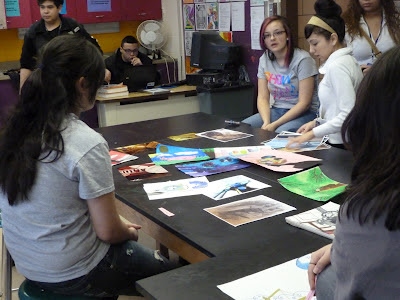
Critique Session at Kennedy High School
Matt Dealy, project manager for the Studio Thinking and American Art project, recently observed Ms. Barron's class at Kennedy High School. He witnessed a very interesting critique session and asked Ms. Barron these follow up questions.
Where did you discover this Critique process?

Where did you discover this Critique process?
Deborah and I were introduced to some of the critique questions at a MCA workshop using a dialogue called, Asking Art 10 Questions. I also used 13 Ways of Looking at a Blackbird to generate other conversational, critique questions. We generated a list of questions which I printed and cut into strips. Students randomly selected a question from a cup as they entered the classroom, laid out their artwork and then engaged in dialogue utilizing the questions as their catalyst. I created this process on my own based from past experience leading critiques.

What drew you to it? What are its strengths?
 Can you briefly describe the steps/process?


I enjoy the idea that students receive a unique question and get to select a piece of work to discuss. I also like that the pressure to generate their own conversations is removed and students have a prompt to which they can respond. The strength of this process is that all the artworks on the table were discussed and all students had an opportunity to speak. This is different from past critiques in that typically the same group of students will participate and their conversation can be a bit simplistic, such as "That's cool" or "That's cute" or "I like it because...". The prompts added variety and diversity to our conversation in that we were not focused solely on the subject matter or the principles or elements of design.
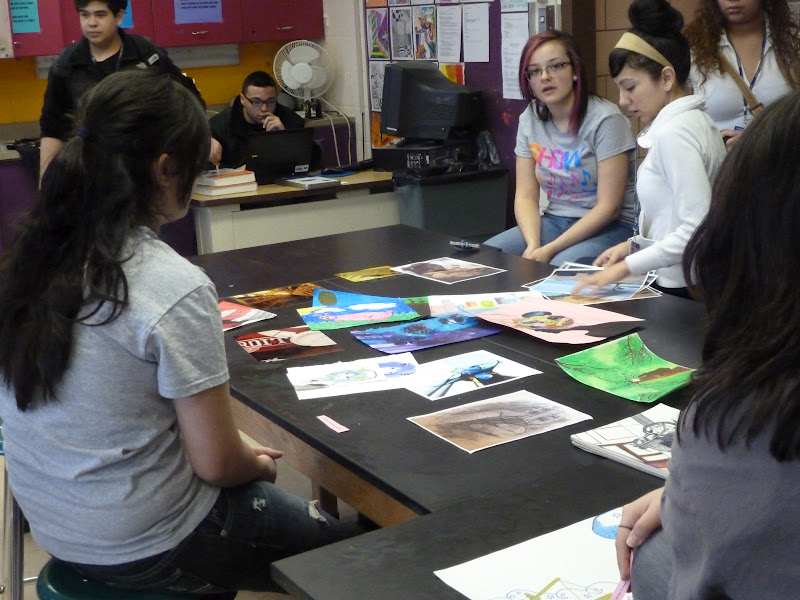
1. Create general questions.
2. Distribute those questions randomly.
3. Begin conversation by modeling how a student might discuss a piece of art using the questions.
4. Call students using a roster to ensure all students participate.
5. Facilitate dialogue to make the critique a conversation.


How could you improve it?


I could improve the process by adding more questions to the bucket for greater variety. Though, it was interesting to see how two students might respond to the same prompt using different artworks. It offered perspective and a level of engagement that was unexpected.


How could you include Studio Thinking?
In the future I will create a series of critique questions utilizing the Studio Habits in order for students to discuss their own work in a group setting. I would most likely use the same process as this critique, but students would have a unique entry into a dialogue about their art-making process.
Wednesday, April 4, 2012
Pre/Post assessment of SHoM
I created a simple pre/post assessment of SHoM. I recently had my Art 1 students complete the top part. At the end of the year, they will complete the bottom part. Next year, this is something that I will do the first week of school and then complete at the end of the year.
After break, students will reflect on a sculpture project by using the lens: Engage & Persist. I am working on a think sheet to give them. This is the first 3-D project they have done. Students had to make the transition from thinking to 2-D to thinking in 3-D. Look for photos of our towers & reflections after spring break.
I've started a Pinterest Board about Studio Thinking.
I found these images that show ShoM and ways to integrate them into other curriculum areas.
Cheryl
Friday, January 6, 2012
Lincoln Park High School Pecha Kucha
Here is the presentation of Beth's work and her students' Studio Habit reflections from our last workshop.
Monday, November 14, 2011
December 7th Assignment: Studio Thinking Test Tools
The Assignment is for each teacher to develop a Reflective Assessment tool for two of the Studio Habits which asks the students to respond to two questions - 1) What just happened?, and 2) Why or how did this happen? So, for Envision, we may want to ask, "What do you envision your next steps are for making this artwork?" and "Why are you making these choices for your next steps?" "How are these choices going to effect your artwork?" The tool should also allow for you to respond to each student through teacher narration (i.e. "This is what I noticed about your ability to envision...").

Please tailor the "What just happened" and "Why or how did this happen" questions to suit your projects, learners' needs, goals, etc. We're looking for reflection around the thinking that happens when students are making work.
The goal is that by the time we meet on December 7th, you have had your students from one class respond to two Studio Habits, and you have responded through a written narration to each student. You can find more sample tools in the Studio Thinking and American Art Google docs. At our next workshop, we will be reviewing and critiquing each others' tools. Please be prepared to share your tool and samples of student responses.
Subscribe to:
Posts (Atom)