Hi, just wanted to share experiences with CR so far.
After I showed them the powerpoint on CR strategy (I taught the steps then we practiced it as a group), I had students practice on their own looking at an image I provided. I included some artist background with the image to help with the context step. Later I have students do their own research regarding the artist.
They looked at an Elizabeth Catlett image and used a form I made (both uploaded to blog).
I had them try this without any help. I was interested to see how they did on their own.
Results:
Students who are used to doing critical thinking in other classes did great (as expected). The IB students handled it like pros. They learned the strategy and were able to apply their usual critical thinking skills to analyze the artwork very well. I found their responses to be very enlightening. As soon as I get a chance, I will upload a few examples.
Then there were students who were interested, learned from me, but did not do this often in other classes or on own. They did "ok". They certainly attempted to think deeply and write about their analysis and understanding. I know with a bit of guidance they will easily reach a higher level of thinking. (I'll also upload a couple examples of these)
Lastly, are the students who struggled with the process. They did not read or really answer the prompts given. They wrote the most basic answer they thought I wanted without really thinking about it. Sometimes they didn't answer at all. Perhaps did not listen or understand when I taught the process by example. These students all told me that they have not had experience in other classes doing this type of work and were frustrated at the level of focus I was asking of them. I can see they will need the most help and guidance learning to think and respond critically. Most of them were freshmen and sophomores. (also provide some ex)
So, I now want to think about the best way to facilitate improvement. Obviously repetition. I'm thinking of arranging heterogenous groups, with a student leader (higher level), a couple of mid-level students, and a couple struggling. If they work together on a few CR, perhaps peer teaching will make a difference.
What do you all think?

Showing posts with label critical thinking. Show all posts
Showing posts with label critical thinking. Show all posts
Friday, September 20, 2013


Thursday, August 29, 2013
Close Read
I used the Close Read format extensively last year. I really like it and enjoyed the Context aspect of it. Before that I had used a more traditional and complex critiquing format (similar to Art Talk).
I've decided to combine the two.
What I like:
What I don't like:
I've decided to combine the two.
What I like:
- Close Read works great for beginning students. It is simplified and it helps them break down the critiquing structure into bits that are easy to do. Gives them the confidence to find "clues" and make inferences. I tell them it's like being a detective.
- Context step helps them make sure they do research on artist, background and make connections. Love it!
- Not too intimidating for 1st year art students in HS. They tend to freak out if we ask for formal analysis as they do not yet have enough experience using elements and principles to create. That comes with time, to have the vocabulary and experience making decisions.
What I don't like:
- The judgment is way too vague, only referring to whether one likes the piece or not. An artistic judgment should include thoughtful responses and analysis of artist's intentions and decisions. Especially to use CR for student work, they need to think about their strengths and weaknesses regarding those decisions in order to make improvements.
- I've added prompts to make a more thoughtful judgment.
- Missing a formal analytical step crucial to more advanced students. This step should address the formal qualities of an artwork, decisions artist made about composition, elements, principles, etc.
- I would add a step for advanced students.
So, with a little tweaking, I am continuing with CR. The cool thing is, it's ALL THE RAGE in CPS. Mentioned in connection to CCSS and CPS preferred way for us to do units. CPS Art programs are strongly encouraging us to use CR. So when I include it in my unit/lesson plans, it hits those points and makes evaluators happy. Will help with my own REACH evaluation.
I made a powerpoint to teach beginning students about CR. Once they get the hang of it, we use this method all year long. I've shared it with Every Art Every Child on Google docs. I don't know how to put a powerpoint on this blog. But maybe EAEC can do that? Matt?
Let me know what you guys do for critiques. I'd love to see other methods. Always learning...
Valerie
Tuesday, December 18, 2012
Art Toys at Hamilton Elementary
Matt recently visited Ms. Schick's studio at Hamilton Elementary to document students at work as they were mid-process in the creation of their own "Art Toy." Students worked independently and collaboratively with assembling found objects/materials to create their own toy. After the class period, Matt and Ms. Schick briefly discussed having students use the Studio Thinking Reflection sheet in one of the next sessions. Here are a couple of video clips of the students talking about their process and a sample of their reflective writing. It is amazing how clearly their critical thinking comes forward through these two methods of data collection.
This student worked independently the entire period as he problem solved how to have his toy stand on its own. In this short clip we see several examples of critical thinking: he is self correcting as he makes changes on his own, he has a clear direction and intentionality, he refers to prior experiences of building things for his little sister, and he is sharing internal verbalizations.
And here is his Studio Thinking reflection:

The two girls in the clip below worked side-by-side throughout the period. Again, we see several examples of their critical thinking coming forward: they are talking to each other and asking each other questions as they develop strategic solutions, they are creating visual representations of their ideas and developing metaphor, and using their drawing/notations as a resource.
And, here is the Studio Thinking reflection for the girl making the "Cat Mermaid."

Below are the Studio Thinking reflections from the other students in the class.


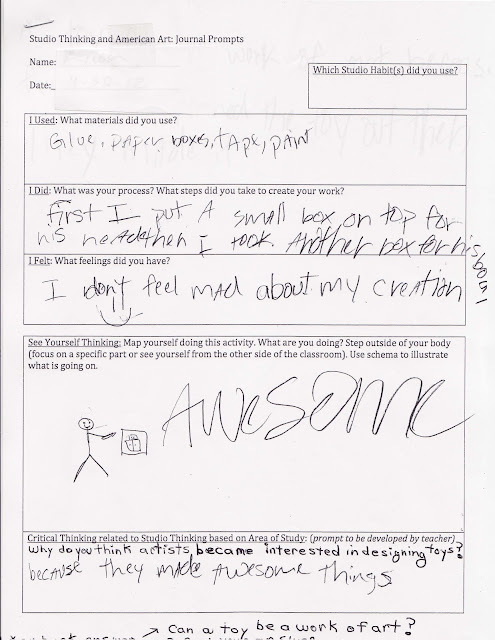


This student worked independently the entire period as he problem solved how to have his toy stand on its own. In this short clip we see several examples of critical thinking: he is self correcting as he makes changes on his own, he has a clear direction and intentionality, he refers to prior experiences of building things for his little sister, and he is sharing internal verbalizations.
And here is his Studio Thinking reflection:

The two girls in the clip below worked side-by-side throughout the period. Again, we see several examples of their critical thinking coming forward: they are talking to each other and asking each other questions as they develop strategic solutions, they are creating visual representations of their ideas and developing metaphor, and using their drawing/notations as a resource.
And, here is the Studio Thinking reflection for the girl making the "Cat Mermaid."

Below are the Studio Thinking reflections from the other students in the class.


Sunday, December 16, 2012
Students reflect on a project and demonstrate critical thinking
Freshman students in my Art 1 class worked on a still life drawing, using charcoal for 2-3 weeks in class. I wanted them to learn several techniques such as laying down a tone on the paper first and pulling out highlights, as well as enlarging a small thumbnail sketch in order to ensure a successful composition. This type of art (Vanitas Still Life using Chiaroscuro) is an ancient form, and so we also spent time learning about that.

Following the completion of their drawings from observation, students spent pretty much an entire class period reflecting on their process and how they felt about it. Below are some of the examples of their written reflections using the template we received in our workshops, as well as some of my thoughts when reading them. I will post some images of the students finished works over winter break- to coincide with their reflections.


-->


 -->
-->


Following the completion of their drawings from observation, students spent pretty much an entire class period reflecting on their process and how they felt about it. Below are some of the examples of their written reflections using the template we received in our workshops, as well as some of my thoughts when reading them. I will post some images of the students finished works over winter break- to coincide with their reflections.

As a teacher, the best part of looking these over is the
drawings the students made of themselves, “map yourself doing this
activity”… I was surprised by how
much information the students’ drawings possessed. They reinforced and expanded
my overall impression of the student and their view of themselves. The drawings demonstrated emotions the
students were feeling and thoughts they had while making their drawing. They
showed this through the way they drew their facial expression, the posture of
the person representing them, and more.
The drawings also remind me of certain actions the students
took, or seminal moments in their process for them, such as placing their
drawing across the room to look at it and noticing it has all the same value.
In many drawings, the students recorded an exact drawing of
the shapes of their piece, upside-down, which reminded me how deep their
connection with that image they struggled with- how ingrained it must be.
Another thing that was really great was reading some of the
students’ “self talk” that they included in their drawing- basically their
inner life as an artist. The way they drew thought bubbles with internal
dialogue was really interesting.
The bubbles described how the students spoke to themselves during the
project, which is not something a teacher could know about without this type of
reflection. Some examples are
“Ani, step down and think”, “don’t look too frustrated”. Students also included dialogue from
their peers that went on, in speech bubbles, which is also valuable information
for how the students were communicating with and helping each other throughout
the process.


 |
| This student stood while she drew, everyday. I like how she captured that, as well as how she seems to be alone in her world. The drawings most students created in this reflection are perfect mini-versions of what they were working on. |
 |
| This student includes an image of himself asking for tips and guidance from other students at his table. |
-->


Another thing that amazed me from reading these reflections
was the HUGE range of emotions that students felt during and about this process
of creating a charcoal still life.
Everything from angry to irritated to sleepy to calm to happy to proud
to nervous to passionate serene and graceful.
I also enjoyed reading about how the students felt this
process would change them as artists, and what prior experiences they had which
impacted their drawing experience.
One student said she felt calm because the objects were peaceful,
another said her interest in antiques fueled her for part of the project.
Others sited family members or drawing classes from the past, or past projects
in my class, which gave them confidence going into the project.
While reading these over, I
tried to keep my eyes open to repeating answers and feelings the students’ had-
trying to learn what the students may have gleaned from the project as a whole. When they answered the 3 questions on
the back, many of them expressed that they learned to be more patient with
drawings and with themselves, that they moved past frustration to make
something they are proud of. 
Many mentioned that they had never worked for so long on
something before. Some mentioned specific things I wanted them to learn, such
as not to outline everything in order to make things look more 3-dimensional. Many of them also mentioned that they
loved charcoal or despised it, and those feelings that were rooted in an
experience with a physical material dictated the direction of their feelings. I
am also glad that each of my students experienced several different emotions
throughout their process, this is true to life during almost any challenging
experience.
As a teacher, I am very glad that many of my students felt
that they learned they needed to be more patient with their work and with
themselves. Many of them expressed
that if they did apply patience and worked hard, their drawing turned out
really well, and they were proud of it. “I learned that if I stick to something, no matter how hard
it might get, I could make something really pretty out of it”.
This is part of what it means to be an artist, and truly
persist beyond what you feel your initial capacities are.


 |
| This student drew a seminal moment in her process, when she set her drawing up across the room to see what needed to me done and get some distance on it. |


 |
| I enjoyed reading about what students were thinking about, in this case music. |
 |
| This student's drawing definitely expresses her sense of anger- the way she drew the clenched hand. |


Thursday, November 8, 2012
Visual Arts and Writing Strategies Workshop, Nov. 1
Thanks to all of you who were able to join us for the workshop last Thursday. We had a great turn out and covered a lot of ideas. We wanted to touch base with everyone regarding the workshop and our next steps.
You Have 7 More Minutes
We sensed many of you were a little frustrated with the amount of time we were able to commit to the collage activity, and this was confirmed in the reflection sheets. We know we presented some complex information and tried to squeeze it all into three hours. This is a common challenge for us and we want you to know that we try to give as much time as possible to the critical components of each workshop.

In this workshop we,
- Reviewed a Sample of Teacher Reflections from the Art Institute PD
- Reviewed the Metacognitive cycle/hologram
- Incorporated Contemporary Art by watching Art 21's piece on Arturo Herrera
- In small groups, created new language systems to communicate events of the CPS strike through collage
- As a large group, shared back Internal Verbalizations
- Transitioned to writing activity through multiple written and visual examples of Stretch & Explore
- In a large group, engaged in word games and writing strategies
- Developed individual writing samples
Why Collage and Writing: Where we are Heading
The Inquiry Question for this workshop was, "How can we develop a new visual sign system to communicate our experience?" We used abstraction and appropriation in both the visual arts and writing to illustrate how the arts support deeper levels of understanding. Then, through the recording of internal verbalizations, individual writing samples, and Studio Thinking reflection prompts, we recorded the critical thinking processes. This process of using visual arts, writing, and Studio Thinking reflection is our main focus for year two of this project.

After reviewing materials and data from year one of Studio Thinking, it was clear teachers were ready to move beyond labeling of Studio Habits to a more complex use of this framework. With our evaluator Cynthia Gehrie's help, we are seeing how Studio Thinking connects to Critical Thinking and Common Core. The Studio Thinking Reflection template we have presented in the last two workshops is the tool we propose using to capture this connection.

Subscribe to:
Posts (Atom)