Monday, May 14, 2012
Sample Interviewing Questions
Wednesday, May 9, 2012
Muscial Table Discussion/Speed Crit
This works great for topic discussions (an example would be when we watched the animated movie "Persepolis", and needed to analyze and discuss it). It also works well for quick student critiques.
There are 6 stations in the classroom where students sit in groups of 4 - 6. I will put a large sheet of paper (18 x 24 or bigger) at each station.
TOPIC DISCUSSIONS:
- In the middle of the paper I will write a prompt (6 different prompts in total, one for each station). I might also provide an art image and written prompt for art history critique.
- Students have pencils ready.
- They have 3 minutes to visit each station as a group.
- At each station, students write (on the large sheet of paper) whatever comes to mind regarding the prompt.
- I have them work their way around the classroom in clock-wise formation.
- During the 3 minute period I play music as a cue for students to write. At the end of each 3 minute section, I stop the music as a cue for students to stop writing and move to the next station. This makes it fun and like the musical chairs game.
- Once the students have gone around the room and are back at their own station, we go into discussion mode.
- Students read the responses to each other and begin discussing the issue at their table.
- Students must find at least 5 main responses to the prompt topic and discuss them. They must have at least 2 responses that someone disagrees with, and discuss why they disagree and what their opposing point is as a result.
- The group "Recorder" writes down what their group discusses in a bullet list formation.
- The next day each group has 3 minutes to present discussion notes to the whole class. Each presentation, students in the class must have at least 1 response to challenge the group, question the group, or make a supportive remark. Often there is more than one response :). The group must counter any class feedback with an answer or explanation of their viewpoint.
- Students receive points for group discussion/recorded notes, and separate points for presentation to class.
- The results of this technique makes for what seems like chaos, but is really several fast-paced and animated discussions. Everyone in the class gets to participate first in a small-group setting for each topic, and then in larger group setting for all topics.
- I find that several things have made people forget about being self-conscious and silent in this kind of group discussion: 1) the whole thing is rather like a game and fun, 2) the fast pace puts pressure on people to come up with a response, 3) prompts give a clear indication of where I want them to start, 4) the structure provides a framework for definite but open-ended answers. 5) the grading structure insures that students must have something to present and a way to respond to the presentations (ensuring a flow of ideas and conversation), 6) since all students write on each of the prompt sheets, there is a sense of sharing information. Students get to use each others ideas to provoke further thought, 7)students become very loyal to their group and want to defend their stance to the class.
- I like to use this for progress critique when students are half way through an artwork and need feedback.
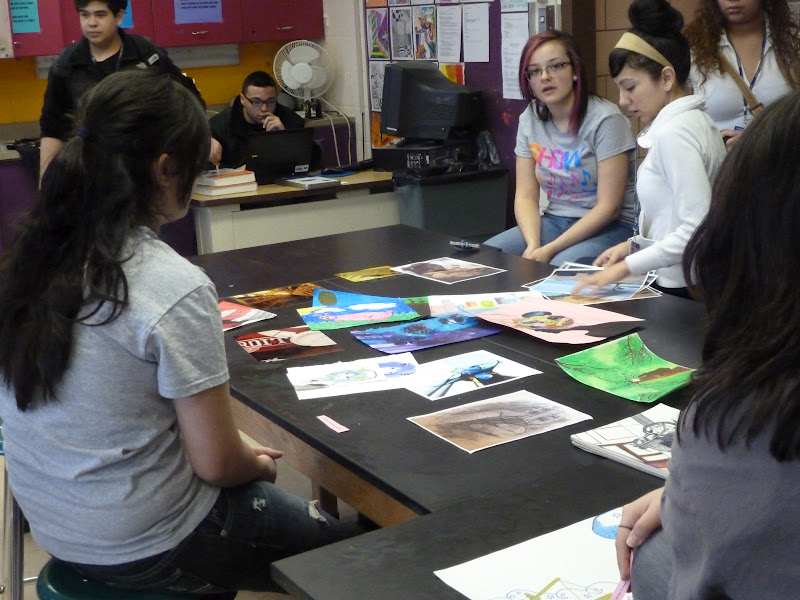
- 6 stations are set up free of clutter. Each student has their artwork placed on the table with a form next to it.
- The form is typed by me and has 3 prompts:
- Strengths
- Weaknesses
- Questions
- In addition are two more sections: "Student response to critique", "Teacher response to critique."
- Students must travel to each station as a group. They have 4 minutes at each station and move around the room in clock-wise formation.
- Music is played to let students know when to write. Music stops and restarts to let students know when to switch stations.
- Student can choose to look at and critique any of the artworks at the table during the 4 minutes.
- They are moving as a group, but not working together as a group. Rather they address artwork and write individually. Often though, they are making verbal comments to each other as they look at the work.
- They must write 3 responses on the form next to the artwork. They must address the 3 prompts.
- All artwork must have responses on the form, so if students see a blank form, they have to make sure that someone writes on it.
- When students have visited all 6 stations, they return to their own station and artwork. They read what their classmates have written.
- Students spend remaining time writing their own reflective response to the critique of their work.
- Artwork and critique forms are turned in to teacher.
- Teacher writes a response to the critique.
- This has proven very helpful in addressing weaknesses in the artwork. I noticed that students take a peer's constructive advice for improvement more often than listen to me tell them the same thing.
- This can be used with the SHoM framework as a topic prompt.
*art projects: Mixed Media Blitz and Materials Madness. I'll describe them in another blog post.
Tuesday, May 8, 2012
Critiquing the Xanos Way
I realized that different people in a good debate group took on different roles. The Agitator/Challenger (my Dad and my son), the Supporter (me and daughter #2), the Lecturer (me or my daughter #3), the Questioner (daughter #1). This was interesting as I had not bothered to analyze family discussions before. I figured that these roles made for some great exchanges that would go round and round and often end up in a completely different place than where we started. I probably should add that my son also fulfills the role of the Joker. You know, the one who makes fun of people when they get too serious. I chose to leave that one out of my experiment as it usually results in someone screaming in our house.
I decided to try to replicate this process, using the roles I mentioned above. My hope was to spur the students into animated and eventually complex discussions. I figured the structure provided by role playing and topic prompts would enable students to work off of each other.
- I teach high school and see students for 46 minutes, 5 days a week.
- In the classrooms, I can have 25 - 35 students in one class. They sit in groups of 4 - 6 at "stations". They make their art there and have small group discussions/projects. Each group has a "recorder". That is a person who writes a bullet list summary of the group discussion for extra credit.
- I have used this particular technique to promote discussion for, 1. a debatable issue (ex. Is Graffiti Art?), 2. To critique a famous work of art, 3. To critique each others art (in progress and at the end), 4. To analyze movies or readings the class encountered.
- I give prompts for topic consideration depending on the issue or type of art being discussed. I might have them focus on concepts, controversy, techniques, or aesthetic success. Along with the prompts they must make certain kinds of statements. In the past I gave them a list (along with the prompts) on paper. These statements must be: a) Challenge a speaker or address a weakness in the piece, b) Support a speaker or address a strength, c) Explain what one thinks is going on (in student critique this role must be the artist), d) Raise at least two questions. I let people choose which of these statements they will make as they travel through the discussion.
- The group starts with the Presenter/Lecturer: the student artist explains their work (or anyone can present the basic facts of the discussion topic.) After this, others in the group can Challenge, Question, or Support in any order they see fit. Anyone can also move back into Presenter mode if needed.
- Students are told that if someone raises a challenge or asks a question, they are allowed to respond. Often a supporter chimes in at this point and others will choose sides or even raise new points. When someone responds to a challenge they have two choices a) agree that there is a weakness and then the group moves into problem-solving mode, or b) disagree and the group moves into debate mode.
- I found that students immediately took to having exciting and interesting discussions. While they were cautioned to keep it civil, the challengers and the questioners made people think and explain themselves. Responders often came up with interesting points that they would not bring up without a "gadfly" in the group. Supporters could bring up positive points that a Presenter might not think of and gave him/her a little back-up. People often switched roles as the discussion progressed.
- At first I was worried this might incite cruel comments. However, I cannot remember any time that students got mean during a discussion. Usually, the Challengers are very diplomatic. Sometimes that role is hard for anyone to choose and I have to help. We do practice giving constructive criticism/disagreement early on. I explain that the Challenger's job is to help the group problem-solve a weakness and therefore find a way to turn it into a strength.
- After discussion, students sometimes present to the rest of the class, using the Recorder's notes. Other times, they just give the discussion notes to me and I read them. During the discussion I walk around and eavesdrop on the groups, offering help when needed.
Kitty's notes on the development of a CPS Arts Assessment
Click on Assessing Design Innovation to read the document.
Tuesday, April 24, 2012
SHoM and Student/Teacher Performance Evaluations
So many questions....
How will student performance be measured? What rubrics will be used? How do we measure data that is not only quantitative but also QUALITATIVE? How do we balance the numbers-driven goals of CPS and the experiential process we know works in the Art Studio? How can student performance be measured in a way to show the VALUE of art teacher performance and our own effectiveness beyond student attendance, grades, and core subject test scores? I am thinking of music, theater, and dance teacher evaluations in addition to the visual arts.
We at CPS need to be sure that the way we are evaluated reflects the way we need to teach. Our curriculum will have to respond to the ways student performance will be measured in addition to the way teacher performance will be measured. I don't know about you, but we are all a nervous wreck here at Curie. It is hard to develop a curriculum without the slightest idea of what those rubrics will be. Not to mention working under the threats made about what happens if we (and our students) don't perform according to the unknown rubric.
So I have been asking questions about WHO is developing these student and teacher evaluations. That same day I got some answers. There is a group being formed by CPS to work on it. Cool, let's get involved! Let's make sure art, music, theater, and dance teachers are on that committee.
Of course I couldn't help but think about how SHoM can play into this process. I have had such success at using this program for the first time this year. I will continue to use it. I wrote to Kate asking how can the data collection developed through SHoM help in our quest to evaluate art students and teachers fairly. She asked me to put these questions on the blog.
So here you are. What will we do? I hope to be part of the conversation and not just a victim to what is decided for next year. I hope to be able to make use of what we have all learned this year for years to come. I hope to lessen my fear of the impending evaluation process, knowing that some of us from SHoM were part of the fair development of rubrics. We all want to measure our own effectiveness without sacrificing the experiential quality of our instruction. How can we do this? I put this question out there... help.
Valerie Xanos
Thursday, April 19, 2012
Tree Paintings
The First Graders at Pershing East Magnet School have been observing trees this school year. This is an attempt to create a long-term science study relevant to each grade/ability level. These longitudinal studies allow studies a chance to observe one specific part of nature over the school year to develop observational skills and develop pattern recognition. The art benefit is the more students observe something, the more details they notice. Their sharpened observations will lead to better artwork, especially in their focused study.
We have drawn trees with pencils, we have photographed trees, we have printed trees, we have painted with both water color and acrylic.
Here are some samples from our acrylic paintings. We read, Sky Tree, by Thomas Locker for inspiration:
Tuesday, April 17, 2012
Critique Session at Kennedy High School
Where did you discover this Critique process?
Thursday, April 5, 2012
Preparing LPHS Art I Students for Studio Thinking
LPHS Mixed Media: Personal Narrative Collage
Concept: (Express, Understand Art World: Domain & Communities) Choose a topic or theme that is of interest to you, and that is important or relevant to you in your life at this time. Your chosen theme/topic should say something about you and/or your personality and interests. Your theme could be related to any or all of the following categories: Personal, political, social, spiritual and everything in between!
from procedure section:
- Begin planning your collage on large paper. (Observe, Stretch & Explore, Engage & Persist) You may alter the size/shape of the background paper, but your final collage may not be smaller than 9” x12” in size. It may be orientated either landscape or portrait.
- When finished, choose 4 Studio Habits to reflect on including Understand Art World: Domain & Communities. Consider process, content and technique! (Reflect: Question & Explain and Evaluate)
| Media Use & Technique: Develop Craft Engage & Persist Stretch & Explore | *Little/no attempt to use mixed media processes (1 medium only) to create collage *Composition not considered | *Applies at least 2 mixed media processes to create collage *Composition needs improvements | *Adequately applies 3 mixed media materials, processes to collage *Evaluates composition for improvements | *Successfully applies 3 or more mixed media materials, processes to collage *Critically evaluates composition for improvements and makes adjustments | _____ |
| • My work looks polished and well crafted because • When I ran into difficulty, the way I solved the problem was • I tried something I had never done before when I | |||||
Wednesday, April 4, 2012
Pre/Post assessment of SHoM
Wednesday, March 28, 2012
Sunday, March 18, 2012
Learning to Observe


Monday, March 5, 2012
Interviewing Ilene - a student artist from Garvey
Sunday, February 26, 2012
American Art and Studio Thinking Unit Planning
Monday, February 20, 2012
Lois Hetland Considers the Current Climate for Arts Education

What are some of the common trends that you see developing as you visit diverse learning environments across the country?
Downside: teacher, parent, child, and administrator frustration with and exhaustion from lack of support, lack of professional community, and lack of connections to their field as artists and art educators; fear and anger at the threat of programs being extinguished; fear and anger at the threat of having to choose between artist-teachers and teaching artists as a cost-saving issue; fear and anger at inadequate art supplies, technological access and training, teaching schedules, class sizes; teachers feeling despair, devalued, misunderstood; lower-income kids getting less arts and turning away (being turned away) from school success; misapplication and misunderstanding of research paradigms, data collection, research design (mono-method paper and pencil high-stakes testing, teaching to the test, ignoring education of the person)