Ms. Drake at Lincoln Park High School invited Kate and Matt to her class to document her students engaging in one-on-one conversations around their collages. The students were given an extended period of time to look closely at one another's collages and to practice participating in an artistic conversation. When they finished looking at one student's work, they switched to looking at the other student's collage. They used the finished pieces, journal sketches and notations, and Studio Thinking reflection sheets to help guide their discussions. I enjoyed listening to these two students as they probed each other regarding their artistic choices. I was impressed with their ability to maintain a meaningful conversation around their art-making and how they really got up close and into the work. Click on the link below to check it out yourself.

Friday, March 29, 2013


Wednesday, March 20, 2013
Online ST Network Conversation, March 18th
On Monday, Matt and Kate hosted our monthly Online ST Network conversation on Adobe Connect. Lois Hetland introduced the second edition of Studio Thinking and facilitated a conversation around:
1) The dispositional elements: An articulation of the skill, alertness and inclination dispositions, and
2) The generative tension in clusters: How do SHoM pull on each other?
In addition to the dispositional elements and generative tensions, Lois and Shirley Veenema unveiled the "Four Full-Color Story Examples of How Habits Interact" section of the new book, which highlights the artwork of four high school students.
Following the presentation on ST2, we watched Art 21 Artist Exclusives on Doris Salcedo and Yinka Shonibare MBE. Participants were invited to share their responses to the short video clips and to note possible SHoM generative tensions.
We had strong participant involvement in this session, which led to some thought provoking conversations and text chatting around artistic thinking, metacognition and best practice. You can check out the entire live recording by clicking on this link.
Stay tuned for what will be covered in our next Online ST Network conversation.
1) The dispositional elements: An articulation of the skill, alertness and inclination dispositions, and
2) The generative tension in clusters: How do SHoM pull on each other?
 |
| Click here to review Lois' entire slide presentation |
Following the presentation on ST2, we watched Art 21 Artist Exclusives on Doris Salcedo and Yinka Shonibare MBE. Participants were invited to share their responses to the short video clips and to note possible SHoM generative tensions.
 |
| by Doris Salcedo |
 |
| by Yinka Shonibare |
We had strong participant involvement in this session, which led to some thought provoking conversations and text chatting around artistic thinking, metacognition and best practice. You can check out the entire live recording by clicking on this link.
Stay tuned for what will be covered in our next Online ST Network conversation.
Friday, March 15, 2013
NAEA National Convention - Forth Worth
Hi Everyone,
We saw some of you last week in Forth Worth, Texas for the NAEA National Convention. Julie Toole, one of our ST Chicago TAB teachers presented a workshop on parent involvement and hosted a TAB open house at her hotel. The open house was a lovely event. Viera Bakova from Curie and I took the plane out together and talked shop in the early hours of the morning.
Kitty Conde presented with Lois Hetland and Sara Stillman (California) around classroom use of the Studio Thinking Framework. The presentation was well attended. Just after this session the second edition of Studio Thinking 2: The Real Benefits of a Visual Arts Education was launched with a signing of the book by Lois. You can buy her book here. Our Chicago Studio Thinking project is in the new edition and Kitty Conde is cited for her practice.
We are inviting attendees from this session to join us in our Studio Thinking Adobe Online Conversation this Monday, March 18th from 7-9 p.m. Central time. The Studio Thinking Online conversation on Monday will address:

We saw some of you last week in Forth Worth, Texas for the NAEA National Convention. Julie Toole, one of our ST Chicago TAB teachers presented a workshop on parent involvement and hosted a TAB open house at her hotel. The open house was a lovely event. Viera Bakova from Curie and I took the plane out together and talked shop in the early hours of the morning.
Kitty Conde presented with Lois Hetland and Sara Stillman (California) around classroom use of the Studio Thinking Framework. The presentation was well attended. Just after this session the second edition of Studio Thinking 2: The Real Benefits of a Visual Arts Education was launched with a signing of the book by Lois. You can buy her book here. Our Chicago Studio Thinking project is in the new edition and Kitty Conde is cited for her practice.
We are inviting attendees from this session to join us in our Studio Thinking Adobe Online Conversation this Monday, March 18th from 7-9 p.m. Central time. The Studio Thinking Online conversation on Monday will address:
The Dispositional Elements of ST: Skill, Alertness and Inclination
and
The Generative Tension in the Clusters: How do the Studio Habits of Mind pull on each other?
Wednesday, March 6, 2013
Teacher Presentations on Online ST Network
On January 26th, the Chicago Teachers' Center hosted an Online Studio Thinking Network conversation
on Adobe Connect. We had three fantastic presentations delivered by
Sara Stillman from Emeryville, California, Valerie Xanos
from Curie High School in Chicago, and Liz Chisholm from Lane Tech
High School in Chicago. These teachers identified questions of importance that they wanted to share with a larger learning community for feedback.
You can take a look at Valerie and Liz's visual presentations in the slideshows below to get a glimpse of the amazing work these teachers are doing. A link to the presentations in their entirety (including audio) can be found at the end of this post.
You can take a look at Valerie and Liz's visual presentations in the slideshows below to get a glimpse of the amazing work these teachers are doing. A link to the presentations in their entirety (including audio) can be found at the end of this post.
 |
| Check out Valerie's entire PowerPoint slideshow here. |
 |
| Check out Liz's entire PowerPoint slideshow here. |
In their presentations, the teachers were asked to address these points:
1) Start with a question, where do you want to go now with your teaching?
2) What's been difficult?
3) Frame or develop a question that is can be researched.
4) Present 10 slides about what you are doing now. Within the ten slides present the context of your practice.
5) What do you want to do next?
You can watch and listen to Sara, Valerie and Liz's entire conversations at this Adobe Connect link.
Teacher Reflective Practice
We invited project teachers to reflect on their experiences using the Studio Thinking Framework in their teaching practice at this half way point in our three year learning community. We're sharing some of these reflections as we know teachers don't hear from each other often enough about how their practice is shifting as a result of using this framework. Thank you teachers for sharing your practice. We are always inspired by your thoughtfulness and commitment to on-going reflective practice. - Kate

Beth Drake from Lincoln Park High School supporting her students as they reflect on their collages.
How has this learning community focused on using Studio Thinking and critical thinking supported your teaching around the development of yourself as a learner within a learning community?
I find that I am more reflective in my practice
as an arts educator-I consistently apply the habits in my lesson design
process/execution/reflection through a studio habits structure. I am looking
closely at what my students are producing as well as what they are
learning/thinking about through process. I make adjustments as needed
throughout and as needed upon lesson/project completion through my reflective
process. We are developing a school-wide instructional focus on critical
thinking at LPHS and visual art is at the forefront of this process. The
methods and strategies that we have developed for self-evaluation, in-progress
and final process/project reflection in the visual art department is being used
as the model for assessing critical thinking school-wide. DiDi Grimm has been
instrumental in presenting our methods of critical thinking in the visual arts,
through the use of studio thinking, to modify and design a rubric for this
school-wide instructional focus area.

My students are gradually learning to "think bigger" as artists. They are no longer reflecting on just what they learned during the current project when they reflect, but they are connecting previous art concepts and aspects of daily life and/or other curricular areas. I am seeing that many students are making connections to artists, processes and concepts from other lesson experiences (in the current and previous year) to what they are making now. I am impressed with the lasting impact that many of the artists that we have studied have on my students. These individuals are meaningful enough in concept and/or technique to make an impression on my students and they draw from these individuals as inspiration. Additionally, they are independently seeking out similar artists and/or processes to inform their work.
"Everything I've done in life is about polarities, about two sides balancing out," says the artist. Carving layers of circles out of the pages of an atlas in order to create topographic islands and canyons, both Lin's studio and outdoor projects mark an identification with the land.
During a recent Mixed Media collage project, I had students making connections to what they learned in Jennifer Salvatore's AP Human Geography class during the spring 2012 semester (our collaborative lesson from last school year). The students studied and explored a variety of human geography and visual art concepts and topics through an in-depth close read of Romare Bearden's "The Dove" as well as through viewing "Visual Jazz," a short documentary about Romare Bearden. The students developed an understanding of Bearden's work and processes through a mind-mapping collage experience that incorporated both visual arts and core content standards through the use of a visual artist and an American artwork as the primary vehicle for learning. I have students currently enrolled in Mixed Media that recalled aspects of that experience, conceptually and technically, as part of the inspiration for a recent collage project experience.

2)How has this learning community focused on using Studio Thinking and critical thinking supported your teaching around the development of your students self awareness as an artist/learner?
Maya Lin Systematic Landscapes Map 2, 2006
In my Mixed Media course, they are constantly making connections with artists, etc. previously studied. For example, we are currently working on a mapping project based on the "Notes for a People's Atlas:People Making Maps of Their Cities" project (http://peoplesatlas.com/). The big idea concept being: "The Personal is Political and the Political is Personal" based on the essay that we read and discussed by Euan Hague (http://peoplesatlas.com/
3) On developing language in the studio that transfers beyond the classroom studio?
4)On thinking dispositions that support the fluid kind of critical, creative and reflective thinking that CCSS requires (going from seeing the discrete bits to seeing connections in and among).
To speak generally (as per the LPHS visual arts curriculum alignment map that you have seen prior), LPHS visual arts experiences at graduated levels through a variety of teaching approaches/philosophies are aligned with studio habits and common core state standards in both language and mathematics. My experiences with my common core ST partner in social science classes reinforces the use of the studio habits dispositions further as noted in the response above.

Student reflective drawing of mixed media assignment in Beth Drake's class at Lincoln Park High school.
Friday, January 18, 2013
A Professional Artist Reflection


*Our professional evaluator uses our tool to explore her own process as a botanical artist.
Name: Cynthia Gehrie
Date: January 16, 2013
Which Studio Habit(s) did you use?
Observe, develop craft, envision
|
I Used: What materials did you use?
I used black walnut ink that I make from black walnut
husks from the trees on the farm.
I also used a French ink paper that was developed for
calligraphy. To make the marks I
used several Speedball nibs that allow me to use a dip ink process to make
very fine lines and larger darker lines. I used natural materials that I collected on my daily walk
in the Shell Ridge preserve in Walnut Creek, CA while visiting my brother and
his family. I gathered
containers to bring water into the studio area and small jars to rinse the
ink out of nibs and for clear water to change the quality of marks in parts
of the drawing. I used soft pastels to add a slight amount of color to parts
of the feather and pinecone.
This dry media was necessary to keep from moving the ink, which is
lightfast but not waterproof.
|
I Did: What was your process? What steps did you
take to create your work?
I set up a drawing area by opening my easel to be flat and
placing a drawing board to make a tabletop. I set out the nibs and practiced with each, noting the
mark I could make with each one, and making a small drawing to show the
quality of line for each. This
helped me select specific nibs for each drawing. I studied each object before drawing it, looking at its
proportions, visualizing how to make the marks that represent visual elements
in the natural materials, and how to use other materials such as water and
pastel to create effects. These
were solutions I came up with in response to questions like, How do I make
the downy part of the feather fluffy?
How do I see, understand and represent the pattern in the
pinecone? How do I use the ink
to get contrast from light to dark?
I needed to develop a strategy to solve the problems that different
elements in the natural materials represented.
|
I Felt: What feelings did you have?
I chose subjects to represent elements in the natural
materials that were challenging for me.
I really did not know whether I would be able to do these drawings in
a successful way. Could I figure
out and represent the pattern and variation in the complex pinecone that used
a spiral, but not exactly or uniformly?
How could I use the variations in form to make the spiral more
interesting and dynamic? Could I
make the close lines of the feather close enough and the down look really
fluffy? I realized that I could use
water to soften the small marks of the down. Selecting the finest crow quill nib helped me to draw the
lines. Would I be able to
separate out the overlapping oak leaves so that they were distinct, yet a
complex unity on the twig? I had
doubt. I began to generate
possibilities, and test them to see how to do them. I began to gain confidence that I had an approach that
might work. I dove in and began
the basic sketch in pencil, then turned to the pen. The great thing about the ink I make is that it is more
forgiving than most ink. It can
be lifted with water if I do so quickly when I realize a mark is wrong. This helps me be more confident
because every mark is not permanent.
I can take more risks. I
can change my mind.
See Yourself Thinking: Map yourself doing this activity. What are you doing? Step outside of your body (focus on a specific part or see yourself from the other side of the classroom). Use schema to illustrate what is going on and add words and thought bubbles as needed.
|
 |
Critical Thinking related to Studio Thinking based on Area of Study: (prompt to be developed by teacher)
Monday, December 31, 2012
Understanding the Studio Habits
I'm new to Armstrong this year so I'm teaching studio habits for the first time to my students. We spent time discussing each habit and students envisioned what each habit looks like in practice. I collected some of the drawings and put them together as a visual aid for my students.


Tuesday, December 18, 2012
Art Toys at Hamilton Elementary
Matt recently visited Ms. Schick's studio at Hamilton Elementary to document students at work as they were mid-process in the creation of their own "Art Toy." Students worked independently and collaboratively with assembling found objects/materials to create their own toy. After the class period, Matt and Ms. Schick briefly discussed having students use the Studio Thinking Reflection sheet in one of the next sessions. Here are a couple of video clips of the students talking about their process and a sample of their reflective writing. It is amazing how clearly their critical thinking comes forward through these two methods of data collection.
This student worked independently the entire period as he problem solved how to have his toy stand on its own. In this short clip we see several examples of critical thinking: he is self correcting as he makes changes on his own, he has a clear direction and intentionality, he refers to prior experiences of building things for his little sister, and he is sharing internal verbalizations.
And here is his Studio Thinking reflection:

The two girls in the clip below worked side-by-side throughout the period. Again, we see several examples of their critical thinking coming forward: they are talking to each other and asking each other questions as they develop strategic solutions, they are creating visual representations of their ideas and developing metaphor, and using their drawing/notations as a resource.
And, here is the Studio Thinking reflection for the girl making the "Cat Mermaid."

Below are the Studio Thinking reflections from the other students in the class.


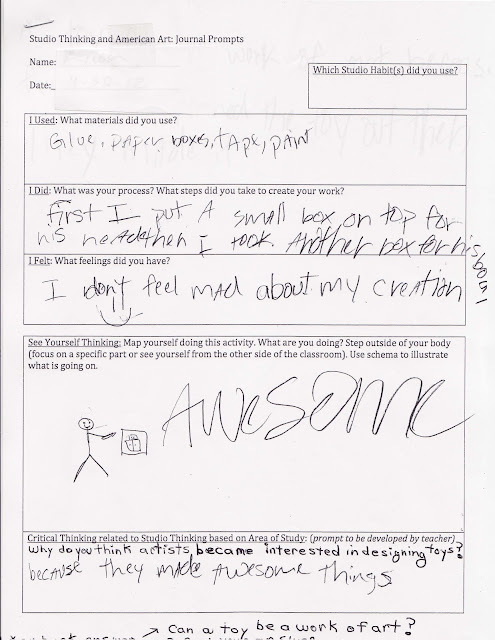


This student worked independently the entire period as he problem solved how to have his toy stand on its own. In this short clip we see several examples of critical thinking: he is self correcting as he makes changes on his own, he has a clear direction and intentionality, he refers to prior experiences of building things for his little sister, and he is sharing internal verbalizations.
And here is his Studio Thinking reflection:

The two girls in the clip below worked side-by-side throughout the period. Again, we see several examples of their critical thinking coming forward: they are talking to each other and asking each other questions as they develop strategic solutions, they are creating visual representations of their ideas and developing metaphor, and using their drawing/notations as a resource.
And, here is the Studio Thinking reflection for the girl making the "Cat Mermaid."

Below are the Studio Thinking reflections from the other students in the class.


Sunday, December 16, 2012
Students reflect on a project and demonstrate critical thinking
Freshman students in my Art 1 class worked on a still life drawing, using charcoal for 2-3 weeks in class. I wanted them to learn several techniques such as laying down a tone on the paper first and pulling out highlights, as well as enlarging a small thumbnail sketch in order to ensure a successful composition. This type of art (Vanitas Still Life using Chiaroscuro) is an ancient form, and so we also spent time learning about that.

Following the completion of their drawings from observation, students spent pretty much an entire class period reflecting on their process and how they felt about it. Below are some of the examples of their written reflections using the template we received in our workshops, as well as some of my thoughts when reading them. I will post some images of the students finished works over winter break- to coincide with their reflections.


-->


 -->
-->


Following the completion of their drawings from observation, students spent pretty much an entire class period reflecting on their process and how they felt about it. Below are some of the examples of their written reflections using the template we received in our workshops, as well as some of my thoughts when reading them. I will post some images of the students finished works over winter break- to coincide with their reflections.

As a teacher, the best part of looking these over is the
drawings the students made of themselves, “map yourself doing this
activity”… I was surprised by how
much information the students’ drawings possessed. They reinforced and expanded
my overall impression of the student and their view of themselves. The drawings demonstrated emotions the
students were feeling and thoughts they had while making their drawing. They
showed this through the way they drew their facial expression, the posture of
the person representing them, and more.
The drawings also remind me of certain actions the students
took, or seminal moments in their process for them, such as placing their
drawing across the room to look at it and noticing it has all the same value.
In many drawings, the students recorded an exact drawing of
the shapes of their piece, upside-down, which reminded me how deep their
connection with that image they struggled with- how ingrained it must be.
Another thing that was really great was reading some of the
students’ “self talk” that they included in their drawing- basically their
inner life as an artist. The way they drew thought bubbles with internal
dialogue was really interesting.
The bubbles described how the students spoke to themselves during the
project, which is not something a teacher could know about without this type of
reflection. Some examples are
“Ani, step down and think”, “don’t look too frustrated”. Students also included dialogue from
their peers that went on, in speech bubbles, which is also valuable information
for how the students were communicating with and helping each other throughout
the process.


 |
| This student stood while she drew, everyday. I like how she captured that, as well as how she seems to be alone in her world. The drawings most students created in this reflection are perfect mini-versions of what they were working on. |
 |
| This student includes an image of himself asking for tips and guidance from other students at his table. |
-->


Another thing that amazed me from reading these reflections
was the HUGE range of emotions that students felt during and about this process
of creating a charcoal still life.
Everything from angry to irritated to sleepy to calm to happy to proud
to nervous to passionate serene and graceful.
I also enjoyed reading about how the students felt this
process would change them as artists, and what prior experiences they had which
impacted their drawing experience.
One student said she felt calm because the objects were peaceful,
another said her interest in antiques fueled her for part of the project.
Others sited family members or drawing classes from the past, or past projects
in my class, which gave them confidence going into the project.
While reading these over, I
tried to keep my eyes open to repeating answers and feelings the students’ had-
trying to learn what the students may have gleaned from the project as a whole. When they answered the 3 questions on
the back, many of them expressed that they learned to be more patient with
drawings and with themselves, that they moved past frustration to make
something they are proud of. 
Many mentioned that they had never worked for so long on
something before. Some mentioned specific things I wanted them to learn, such
as not to outline everything in order to make things look more 3-dimensional. Many of them also mentioned that they
loved charcoal or despised it, and those feelings that were rooted in an
experience with a physical material dictated the direction of their feelings. I
am also glad that each of my students experienced several different emotions
throughout their process, this is true to life during almost any challenging
experience.
As a teacher, I am very glad that many of my students felt
that they learned they needed to be more patient with their work and with
themselves. Many of them expressed
that if they did apply patience and worked hard, their drawing turned out
really well, and they were proud of it. “I learned that if I stick to something, no matter how hard
it might get, I could make something really pretty out of it”.
This is part of what it means to be an artist, and truly
persist beyond what you feel your initial capacities are.


 |
| This student drew a seminal moment in her process, when she set her drawing up across the room to see what needed to me done and get some distance on it. |


 |
| I enjoyed reading about what students were thinking about, in this case music. |
 |
| This student's drawing definitely expresses her sense of anger- the way she drew the clenched hand. |


Thursday, December 13, 2012


Valerie introduces a unit on Tiny Town
Valerie at Curie High school introduces a new unit for her Guerilla Art Class focused on Tiny Town.She invites students to create narratives with miniatures. She shares with us some background information on the artist Slinkachu who creates these inspired tiny installations in public spaces.
Monday, December 3, 2012
Performance Assessment Tasks
Liz shares a performance assessment task from her Art 1 class. Within their writing sample students call out specific Studio Habits. Some students are paraphrasing the language posted about the Habits.
Liz presents students with options for demonstrating knowledge but leaves room for their own decision making. How do you use performance assessments in your class? Please share.
To see more from Liz's studio at Lane Tech, check out their blog by clicking here.
Saturday, November 17, 2012
Online Studio Thinking Network
On November 19th, Louise Music from Alameda County's Office of Education's Department of Integrated Learning presented through our Adobe Connect Online ST Network on the connections of Common Core and the Studio Habits of Mind. This was followed up with a conversation focusing on two questions:
1) What are arts educators contributing to the general endeavor of teaching to a Common Core?
2) What are arts educators getting from the general endeavor of teaching to a Common Core?
Check out a video recording of the conversation at this link: Adobe Connect STF Network Session 3
*you may want to fast forward through the first 11 minutes as people are entering the conversation. Louise starts her presentation close to the 11 minute mark.

1) What are arts educators contributing to the general endeavor of teaching to a Common Core?
2) What are arts educators getting from the general endeavor of teaching to a Common Core?
Check out a video recording of the conversation at this link: Adobe Connect STF Network Session 3
*you may want to fast forward through the first 11 minutes as people are entering the conversation. Louise starts her presentation close to the 11 minute mark.

Subscribe to:
Posts (Atom)